Best 5/3/1 Spreadsheet Template: Wendler's Program in Google Sheets
5/3/1 spreadsheet templates tested for Google Sheets and Excel. Auto-calculate training max, percentages, and progression. Compare options.

From Sort & Keep, the maker of the linked templates. Our current product prices update with your selected currency. Worked examples and third-party prices keep their stated currency and date.
Jim Wendler's 5/3/1 is probably the most popular intermediate strength program ever written. Simple concept, proven results, thousands of lifters running it at any given time. But if you have ever tried to run it without a 5/3/1 spreadsheet template, you know how quickly the math gets annoying. Four lifts, each with a training max. Three weeks of percentages that change every session. A deload every fourth week. Then you bump the training max and recalculate everything from scratch.
Get one number wrong in week one and every subsequent session is off. Errors compound across cycles, and three months in you are either lifting too heavy or too light. A good spreadsheet eliminates all of that.
Free community sheets, paid products, and dedicated apps. To find which ones actually handle the program correctly across multiple cycles and variants.
How 5/3/1 Works (The 60-Second Version)
If you already know the program, skip ahead. For everyone else, here is the framework that every spreadsheet on this list needs to support.
Training Max (TM). You do not program off your actual one-rep max. You take 85-90% of your true 1RM and use that as your training max. If your squat 1RM is 180kg, your TM is 153-162kg. This built-in conservatism is the reason the program works long-term. You are never grinding from day one.
The 3-Week Wave. Each cycle runs three weeks before a deload:
- Week 1 (5+): 3 sets at 65%, 75%, 85% of TM. Last set is AMRAP (as many reps as possible).
- Week 2 (3+): 3 sets at 70%, 80%, 90% of TM. Last set is AMRAP.
- Week 3 (1+): 3 sets at 75%, 85%, 95% of TM. Last set is AMRAP.
Deload (Week 4). Drop to 40-60% of TM for recovery. Some lifters run the 7th Week Protocol instead. Test your TM with a single at your training max weight to confirm it is still appropriate.
Progression. After each cycle, increase your TM by 2.5kg for upper body lifts (bench, overhead press) and 5kg for lower body lifts (squat, deadlift). That is it. Slow, deliberate, sustainable.
AMRAP Sets. The plus sets are where the magic happens. Hitting 85% for 5+ reps means your TM is appropriate. Hitting it for 8-10 means you have room to grow. Hitting it for only 3 means your TM is too high. A good 5/3/1 spreadsheet template needs to track these numbers because they are your primary feedback mechanism.
What a Good 5/3/1 Spreadsheet Must Calculate
Training max from 1RM. Enter your actual or estimated max, and the spreadsheet should calculate your TM at 85% or 90% automatically. Bonus if it lets you toggle between the two.
Weekly percentages. The core sets for all three weeks, calculated from TM, rounded to the nearest plate-loadable weight. A spreadsheet that tells you to load 73.125kg is useless. You need it rounded to 72.5kg or 75kg depending on your gym's smallest plates.
AMRAP tracking. The top set each session is an AMRAP. The spreadsheet needs a field for actual reps performed, not just prescribed reps. This is the data that tells you whether your TM is calibrated correctly.
Estimated 1RM from AMRAP. If you hit 85% of your TM for 7 reps, what does that imply about your actual 1RM? Epley and Brzycki formulas should be built in so you can watch your estimated max trend upward across cycles.
TM progression over cycles. Auto-increment by 2.5kg upper / 5kg lower after each completed cycle. A spreadsheet that makes you manually recalculate every four weeks is barely better than pen and paper.
Accessory work. BBB adds 5x10 at 50-60% of TM. FSL repeats the first set for additional volume. The spreadsheet needs to calculate supplemental work, not just the main sets.
Joker sets (optional). Additional singles at 5-10% above your top working set on good days. Not every template tracks these, but the good ones include a field for it.
Multi-cycle view. After six months you have run 6+ cycles. Seeing your TM and estimated 1RM plotted across all of them is how you confirm the program is working long-term.
The Best 5/3/1 Spreadsheet Templates Reviewed
1. R/Fitness Wiki 5/3/1 Spreadsheet. Best Free Starting Point
Platform: Google Sheets / Excel
Price: Free
Best for: Lifters running vanilla 5/3/1 or BBB for the first time
The Reddit r/Fitness wiki links to several community-maintained 5/3/1 spreadsheets, and the most commonly shared one has been iterated on for years. You enter your 1RM for each lift, select your TM percentage (85% or 90%), and the sheet generates all three weeks of main work plus a deload week.
Pros:
- Completely free, well-tested by thousands of users
- Covers the base 5/3/1 percentages accurately
- Includes BBB supplemental work (5x10 at configurable percentages)
- Clean enough layout for gym use on mobile
- AMRAP field for the top set each session
Cons:
- No automatic TM progression between cycles. You manually update your maxes
- No estimated 1RM calculation from AMRAP performance
- No Joker set tracking
- Limited to one cycle view; no multi-cycle trend data
- Plate rounding is inconsistent (sometimes gives you unloadable weights)
- No accessory tracking beyond BBB sets
Verdict: The best free option for your first cycle or two. You will outgrow it once you want to track trends across cycles or run anything beyond base 5/3/1 and BBB.
2. NSuns 5/3/1 LP Spreadsheet. Best Free Template for Aggressive Progression
Platform: Google Sheets / Excel
Price: Free
Best for: Late beginners and early intermediates who want faster progression than standard 5/3/1
Technically a 5/3/1 variant rather than Wendler's original, but it is so widely used that any 5/3/1 spreadsheet roundup would be incomplete without it. The nSuns spreadsheet auto-calculates 8-9 working sets per main lift (more volume than standard 5/3/1) and adjusts your TM weekly based on AMRAP performance.
Pros:
- Free and extensively battle-tested by the r/nSuns community
- Weekly TM auto-adjustment based on AMRAP reps (not just every 4 weeks)
- Built-in progression logic removes guesswork
- Covers two main lifts per session (T1 + T2)
Cons:
- Not actually Wendler's 5/3/1. Different set/rep scheme, different progression model
- Very high volume (17 sets of main work per session) that can be unsustainable
- Confusing layout with dense formulas across multiple tabs
- No deload protocol, no BBB/FSL support
Verdict: Excellent if you specifically want to run nSuns. Not the right template if you want Wendler's 5/3/1 as written.
3. Boostcamp App. Best Free App Alternative
Platform: iOS and Android
Price: Free (ad-supported)
Best for: Lifters who prefer an app interface over spreadsheets
Boostcamp includes several pre-built 5/3/1 templates (BBB, FSL, and a few community variants). You enter your maxes, and the app generates your training sessions. It tracks AMRAP reps and adjusts your TM at the end of each cycle.
Pros:
- Free with no feature gating (supported by ads)
- Clean interface optimized for between-set logging
- Multiple 5/3/1 variants pre-built
- Automatic TM progression after each cycle
Cons:
- Cannot customize program structure beyond what templates allow
- No estimated 1RM calculation, Joker sets, or long-term trend visualization
- Ad-supported. Banner ads between sets
- Your data lives on their servers, not your own
Verdict: The most convenient option if you want to run 5/3/1 without a spreadsheet. Limited once you want customization or long-term analytics.
4. Five3One App. Best Dedicated 5/3/1 App
Platform: iOS
Price: £4.99 one-time
Best for: iOS users who want a purpose-built 5/3/1 tracker
Five3One is built specifically for Wendler's program and covers more variants than any other app. It handles BBB, FSL, SSL, Widowmakers, Joker sets, 7th Week Protocol, and leader/anchor cycles from 5/3/1 Forever.
Pros:
- Supports nearly every official 5/3/1 variant
- Joker set tracking with auto-calculated weights
- TM test protocol built in (7th Week)
- One-time £4.99 purchase, no subscription
- Plate loading visualization
- AMRAP tracking with rep PR history
Cons:
- iOS only. No Android or desktop version
- No spreadsheet export; data is locked in the app
- No estimated 1RM trend charts
- No volume load or per-muscle-group analysis
- Accessory tracking is basic (log only, no programming)
- If the developer stops updating, your data has no escape hatch
Verdict: The best dedicated 5/3/1 app on iOS. Covers more variants than anything else in this list. The lack of data export and analytics is the trade-off for convenience.
5. Wendler Log App. Best for 5/3/1 Forever Programming
Platform: iOS and Android
Price: Free (basic) / $9.99/year (premium)
Best for: Lifters running leader/anchor cycles from 5/3/1 Forever
Another purpose-built 5/3/1 app. The differentiator is leader/anchor framework support from 5/3/1 Forever. Run 2-3 leader cycles (volume focus) followed by 1-2 anchor cycles (intensity focus).
Pros:
- Leader/anchor cycle support that no spreadsheet handles well
- Supports BBB, FSL, SSL, BBS, and Widowmaker supplemental work
- TM auto-progression with manual override
- Free tier is functional for basic 5/3/1
Cons:
- Premium features behind a $9.99/year subscription
- No Joker set tracking or estimated 1RM on the free tier
- Limited long-term analytics and no data export without premium
Verdict: Worth trying if you are deep into 5/3/1 Forever programming. The subscription is modest, but Five3One offers more for a one-time fee.
6. Sort & Keep Strength Training Log. Best 5/3/1 Spreadsheet for Long-Term Tracking
Platform: Google Sheets / Excel
Price: £4.99 one-time
Best for: Lifters who want 5/3/1 tracking with full progressive overload analytics
Full disclosure: we built this. But we built it because the free 5/3/1 templates handle the first cycle fine and then leave you with no way to see whether the program is actually working over months.
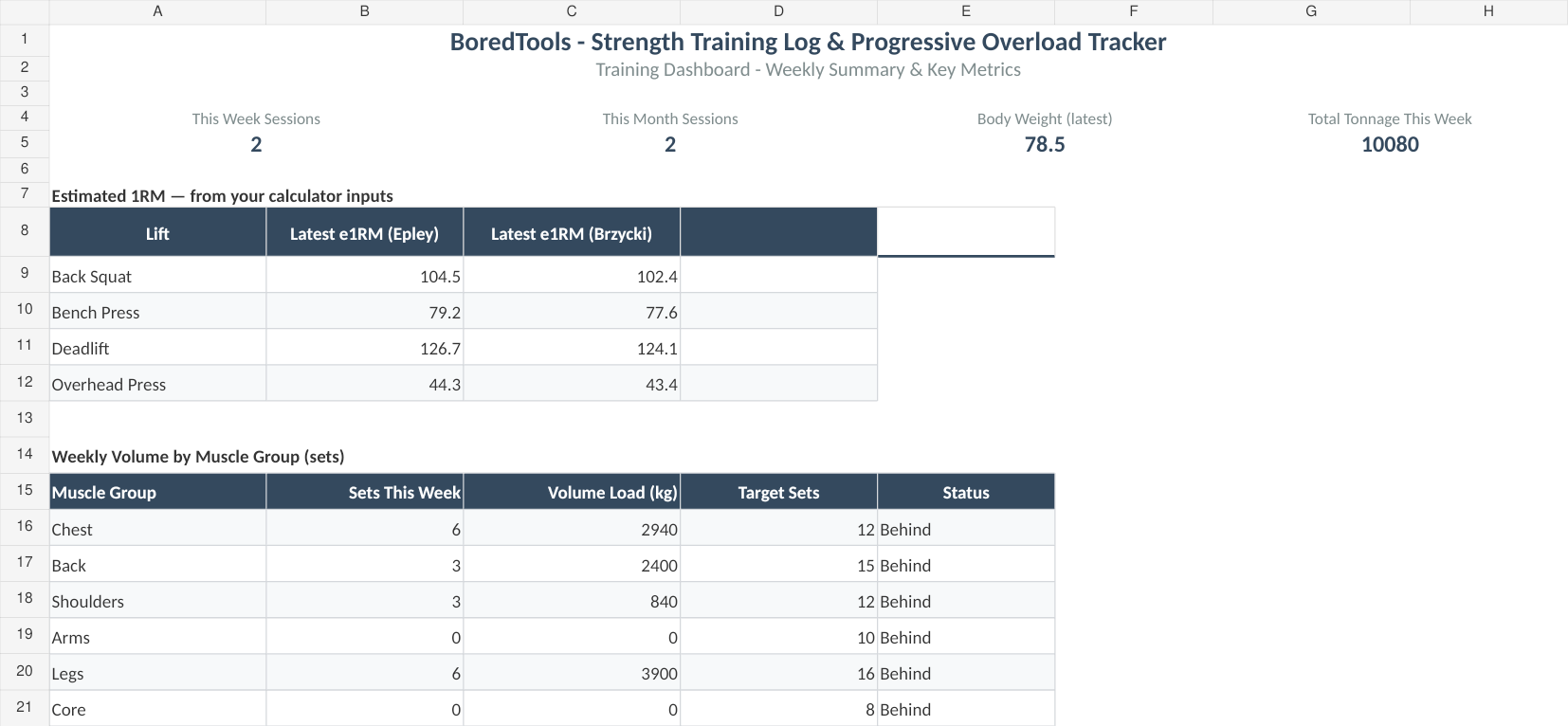
The Strength Training Log (Sort & Keep) is not a 5/3/1-only template. It is a general strength training spreadsheet with features that make it particularly effective for percentage-based programs like 5/3/1. You get a built-in 1RM calculator (Epley and Brzycki) that estimates your max from every AMRAP set, volume load tracking per exercise and per muscle group, and progressive overload indicators that show whether your estimated strength is trending up, down, or stagnant across cycles.
UK edition tracks in kg with press-ups, personal bests, and metric defaults. US edition tracks in lbs with push-ups and personal records. Same progressive overload science. Your preferred units.
For 5/3/1 specifically, this means:
- Enter your TM once and the percentage tables generate your working weights for all three weeks, rounded to plate-loadable increments
- Log AMRAP reps on every plus set and watch your estimated 1RM update in real time
- Track supplemental work (BBB, FSL, or custom) with the same volume tracking as your main lifts
- See multi-cycle trends. After three cycles, the dashboard shows whether your squat, bench, deadlift, and overhead press estimated maxes are climbing at the rate you expect
- Periodization support for leader/anchor programming or any other block structure
- RPE tracking per set, so you can spot fatigue accumulation before it stalls your progress
Pros:
- Full progressive overload analytics, not just a percentage calculator
- Works for 5/3/1 and any other program (GZCL, conjugate, custom)
- Estimated 1RM from AMRAP sets with trend charts across cycles
- Volume load per muscle group including accessories
- £4.99 one-time, Google Sheets and Excel compatible
- You own your data. No app shutdown risk
- RPE and fatigue trend analysis
Cons:
- Not a dedicated 5/3/1 template. You set up the percentages rather than selecting "BBB" from a dropdown
- Manual data entry (no wearable integration)
- Newer product with a smaller community than Reddit templates
Verdict: If you plan to run 5/3/1 for six months or longer and you want to actually see the program working through data, this is the spreadsheet that scales with you. The free templates handle the math for one cycle. This handles the analysis across all of them. Get the Strength Training Log on Sort & Keep | Also on Sort & Keep (£4.99) or read the full feature breakdown.
5/3/1 Variant Comparison: What Each Spreadsheet Needs to Track
Not all 5/3/1 is the same. The variant you run determines what your spreadsheet actually needs to calculate. Here is how they differ.
Original 5/3/1
The base program. Three main working sets per session, top set is AMRAP, supplemental work is dealer's choice. A spreadsheet only needs to calculate training max, the three weekly percentage sets, and track AMRAP reps. Any template on this list handles it.
Boring But Big (BBB)
After your main work, you do 5 sets of 10 reps at 50-60% of your TM. That is 50 additional reps of the main lift (or a variation). Substantial volume that accumulates fatigue differently than the main sets.
What the spreadsheet must track differently: BBB percentages (typically 50%, but Wendler prescribes cycles increasing to 60% and 70% across leaders), total supplemental volume separate from main work volume, and recovery indicators.
First Set Last (FSL)
After your main work, you repeat the weight from your first working set for 3-5 additional sets. On Week 1, that is 65% of TM. On Week 3, that is 75%. Less volume than BBB but easier to recover from.
What the spreadsheet must track differently: The FSL weight changes weekly, so the spreadsheet must dynamically calculate supplemental weight per week rather than using a static percentage.
Coffinworm
A hybrid from 5/3/1 Forever that mixes different weeks' percentages within a single session. The 5+ percentages for warm-up sets and the 1+ percentage (95%) for the top set. Most free templates break here because they assume each session uses percentages from a single week. Only flexible spreadsheets or dedicated apps handle Coffinworm correctly.
Quick Variant Reference
| Variant | Main Sets | Supplemental | Volume Level | Spreadsheet Complexity |
|---|---|---|---|---|
| Original | 3 (AMRAP top set) | Flexible | Low-Moderate | Any template works |
| BBB | 3 (AMRAP top set) | 5x10 at 50-60% TM | High | Needs BBB percentage calc |
| FSL | 3 (AMRAP top set) | 3-5 sets at Week's 1st set weight | Moderate | Needs dynamic weekly calc |
| Coffinworm | 3 (mixed percentages) | FSL | Moderate-High | Needs custom % per session |
Final Recommendation
- "I am running basic 5/3/1 or BBB for the first time and want something free." Use the r/Fitness wiki spreadsheet. It covers the essentials and costs nothing.
- "I want an app and I am on iOS." Five3One (£4.99) covers more variants than any other app and has no subscription.
- "I want aggressive weekly progression, not standard 4-week cycles." The nSuns spreadsheet is free and purpose-built for that, but understand it is not Wendler's program.
- "I am running 5/3/1 long-term and want to see whether the program is working across cycles." The Sort & Keep Strength Training Log (Sort & Keep) (£4.99) gives you estimated 1RM trends, volume analytics, and progressive overload tracking that the free templates do not.
The free community spreadsheets are genuinely good for getting started. The point where they fall short is the same point where 5/3/1 gets interesting. Cycle 4, 5, 6. When you need data, not just a calculator, to confirm the program is working. That is what we built the Strength Training Log to solve.
Related Reads
- Strength Training Log & Progressive Overload Tracker: Full Feature Breakdown
- How to Track Progressive Overload in Google Sheets
- Best Workout Log Spreadsheets for Progressive Overload (2026)
Get free spreadsheet templates and updates. New templates, feature updates, and practical guides delivered to your inbox. No spam, unsubscribe anytime.
Subscribe free → | Already have a template? Download the free budget tracker or free meal planner. No email required.
Choose the right next step
The Strength Training Log is a progressive-overload tracker spreadsheet and workout log for Google Sheets or Excel, built for recording the work and deciding what to increase next.