Budget Template for Low Income: Making Every Pound Count
Budget template for low income households. Track Universal Credit, zero-hours wages, and benefit entitlements. Get the template.

From Sort & Keep, the maker of the linked templates. Our current product prices update with your selected currency. Worked examples and third-party prices keep their stated currency and date.
When your take-home pay is below the national median, most budgeting advice reads like it was written by someone who has never checked their bank balance before buying groceries. "Pay yourself first." Pay yourself with what? "Follow the 50/30/20 rule." When rent, food, and utilities already consume 80% or more of your income, that framework doesn't just fail. It makes you feel like the problem is you. It isn't.
We built this guide for people on low incomes in the UK. Those earning under roughly £25,000, receiving Universal Credit, working zero-hours contracts, or cobbling together income from multiple part-time jobs. The goal is not financial growth. The goal is stability. Knowing what comes in, what goes out, and making sure you are claiming everything you are entitled to.
That last part matters more than any spreadsheet formula. Unclaimed benefits are the single biggest source of "found money" for low-income households, and the right budget template for low income earners puts that front and centre.
Why You Need a Budget Template for Low Income Specifically
Generic budget templates are designed for people with predictable monthly salaries and enough headroom to choose where discretionary spending goes. If that is not your situation, here is why they break down:
They assume discretionary spending exists. The 50/30/20 split allocates 30% to "wants." When your income is £1,200/month and rent alone is £650, there is no 30% for wants. There might not be 5%. A template that guilt-trips you about an entertainment budget you do not have is worse than useless. It is demoralising.
They do not track benefits. Universal Credit, Personal Independence Payment, Carer's Allowance, Child Benefit, Council Tax Reduction, Pension Credit. These are real income for millions of people. A single "Monthly Income" field does not cut it when your money arrives from three different sources on three different dates, with one of them (UC) calculated monthly but paid five weeks after your assessment period ends.
They ignore irregular income. If you are on a zero-hours contract, your income can swing by £200-£400 between months. Agency work, gig economy shifts, seasonal employment. None of this fits a template that asks you to enter one number and assumes it stays the same. You need income averaging across 3-6 months minimum to build a budget you can trust.
They do not know about deductions. Universal Credit payments can have deductions for advance repayments, overpayments, third-party debt, or sanctions. Your "income" on paper and the amount that actually hits your account are often different. A good template tracks the gross UC entitlement and every deduction separately.
They focus on optimisation, not survival. Advice like "reduce your subscriptions" or "batch cook to save money" assumes you have subscriptions and can afford ingredients in bulk. When you are choosing between heating and eating. And 4.3 million UK households faced fuel poverty in 2024/25. The priority is making sure nothing falls through the cracks, not micro-optimising your grocery shop.
A standard 50/30/20 template works once you have breathing room. Getting to that point requires a different framework entirely.
The Low-Income Budget Framework
Forget percentage-based allocation. When money is tight, you need a priority stack. A strict order of operations that ensures the most critical things get covered first, even in a bad month.
1. Survival Essentials (Non-Negotiable)
These are the costs where missing a payment creates a crisis. Eviction, disconnection, legal action:
- Rent or mortgage (including any shortfall between Local Housing Allowance and actual rent)
- Council Tax (check eligibility for Council Tax Reduction. Up to 100% discount depending on your council)
- Gas and electricity (prepayment meters cost more. If you are on one, ask your supplier about switching to direct debit)
- Water
- Food
Know this number to the penny. This is your survival floor. Everything in the budget exists to protect this number first.
2. Benefit Optimisation (The Biggest Lever You Have)
Before you budget a single pound of discretionary spending, check that you are receiving every penny you are entitled to. This is not optional. It is the single highest-impact financial action available to most low-income households.
Common entitlements people miss:
- Council Tax Reduction. Not the same as Single Person Discount. Many low-income households qualify for 50-100% reduction and do not claim it.
- Warm Home Discount. £150 off your electricity bill per year, applied automatically if you receive Pension Credit Guarantee, but you may need to apply if you are on UC with high energy costs.
- Free school meals. Worth approximately £400-£500 per child per year. Eligibility threshold is UC with net earnings below £7,400/year.
- Healthy Start vouchers. £4.25/week per child under 4 (£8.50 if under 1) for milk, fruit, vegetables, and vitamins. You qualify on UC if your household income is under £408/month.
- NHS Low Income Scheme. Free prescriptions, dental treatment, eye tests, and travel costs for hospital appointments.
- Household Support Fund. Discretionary grants from your local council for food, energy, and essential items. Each council runs this differently; contact yours directly.
- Broadband social tariffs. Most major providers offer £12-£20/month packages for UC recipients. BT, Virgin Media, Sky, Vodafone, and others all have them.
Running an entitlement check typically takes 15-20 minutes and can surface £100-£300/month in missed income. We will cover the best tools for this below.
3. Debt Minimum Payments
If you carry debt, minimum payments come next. Not aggressive repayment. Minimums only at this stage, because the priority is keeping your head above water and avoiding default.
- Credit cards and store cards (minimum payment)
- Overdraft charges
- Council Tax arrears (set up a payment plan. Councils must accept reasonable offers)
- Benefit advance repayments (these are deducted automatically from UC, but know the amount)
If your debt is unmanageable, StepChange and National Debtline offer free, non-judgmental advice. They can negotiate with creditors on your behalf and set up Debt Relief Orders (DROs) for debts under £30,000 with a one-off £90 fee.
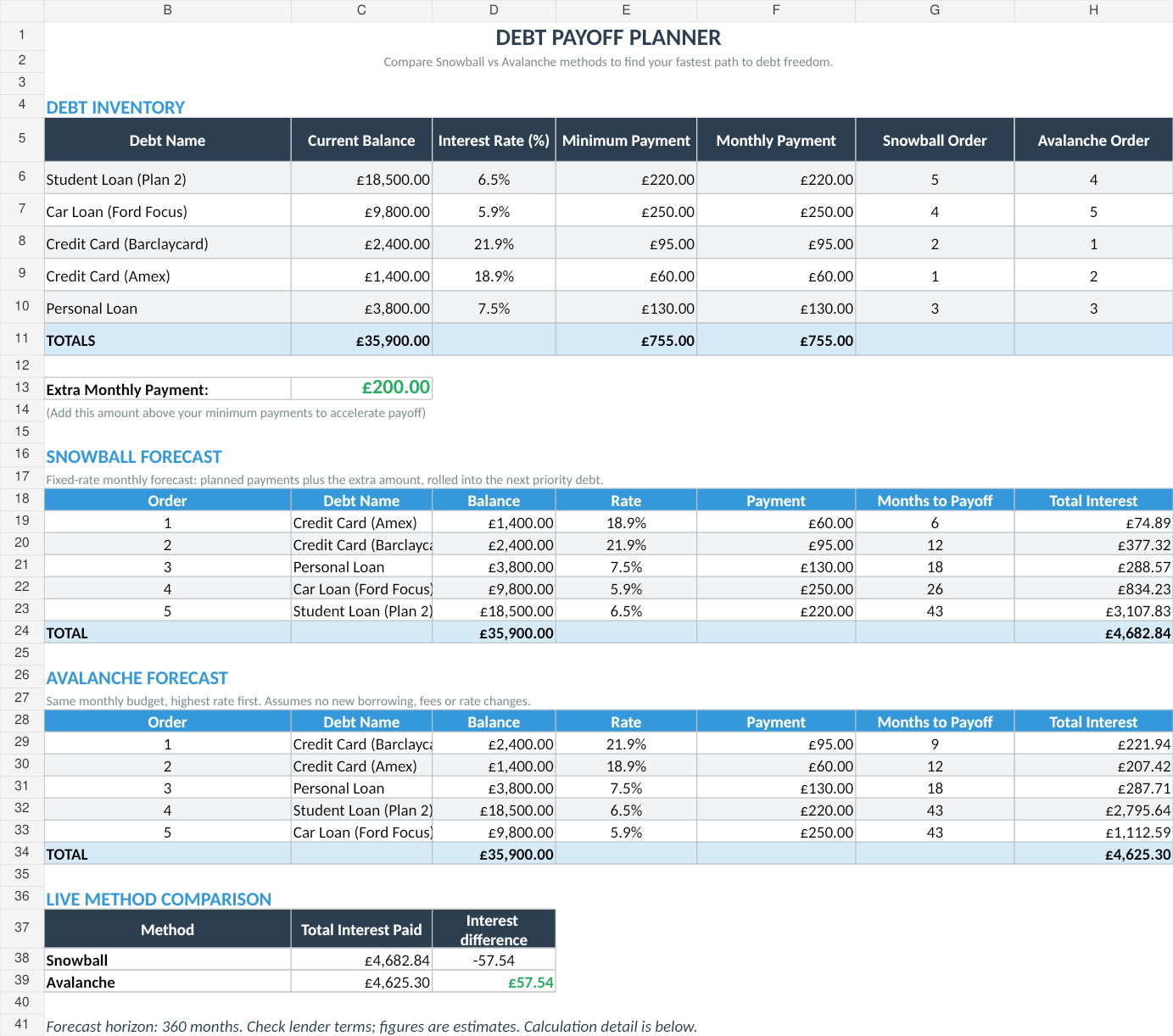
Once you have stability, a debt payoff calculator helps you decide between snowball and avalanche strategies. But that is a later step. Survival first.
4. Micro-Savings (Even £5 Matters)
This sounds almost insulting when money is this tight, but hear us out: the difference between £0 in savings and £50 in savings is enormous. Not financially. Psychologically. It is the difference between "I have no options" and "I have one week of breathing room."
- Immediate target: £50 in an instant-access account
- Next target: £250 (enough to cover most emergency boiler/appliance callouts)
- Stretch target: One month's survival essentials
Even £5/month is a start. The point is not the amount. It is breaking the cycle of every unexpected cost going on credit.
5. Breathing Room (Everything Else)
Whatever is left after the above four layers. Subscriptions, social spending, clothing, transport beyond essentials, anything discretionary. For some months this might be £20. For some months it might be nothing. That is the reality, and a good budget template does not pretend otherwise. When this number is consistently near zero, the answer is not "budget harder". It is to revisit layer 2 (benefit optimisation) and make sure no entitlement is being left on the table.
5 Ways to Track a Low-Income Budget
Critically. Cost. Paying £10/month for a budgeting app defeats the purpose.
1. Pen and Paper
Platform: Physical notebook
Price: Free (or nearly. A £1 notebook from a pound shop)
Setup time: 10 minutes
Write your income sources and dates down the left side. Write every expense on the right. Subtract. That is it.
Pros:
- Genuinely free
- No technology barriers. Works for everyone regardless of digital confidence
- Physically writing numbers makes them more real for many people
- Cannot be hacked, does not need Wi-Fi, never runs out of battery
Cons:
- No automatic calculations. You are doing maths by hand
- Easy to lose the notebook or fall behind on entries
- No way to see trends over months without significant effort
- Cannot average irregular income without a calculator
Verdict: Underrated. If apps and spreadsheets feel overwhelming, a notebook and a pen is infinitely better than no system at all. The best budget method is the one you will actually stick with.
2. Banking Apps With Spending Pots (Monzo / Starling)
Platform: iOS, Android
Price: Free
Both Monzo and Starling let you create "pots" or "spaces". Sub-accounts within your main account where you can ring-fence money for specific purposes. When your UC or wages arrive, you immediately move rent to the Rent pot, utilities to the Bills pot, and so on. What is left in your main balance is what you have to spend.
Pros:
- Free accounts with no monthly fee
- Pots/spaces physically separate your money so you cannot accidentally spend rent on groceries
- Real-time spending notifications help you stay aware
- Salary sorting (Monzo Plus) or standing orders to pots automate the process
- Both offer fee-free cash withdrawals and no foreign transaction fees
Cons:
- Salary sorting requires Monzo Plus (£5/month). Though manual pot transfers are free
- No specific benefit tracking or UC payment date awareness
- Spending categories are preset and not designed for benefit income
- If you are paid in cash or through an employer who only does bank transfers to specific banks, switching may not be practical
Verdict: Excellent for the "envelope method" digitally. The act of moving money into pots on payday is powerful. But you still need a separate system (even pen and paper) to track benefit entitlements and plan across months. The pots handle the "where does this money go" problem; they do not solve the "am I getting everything I should" problem.
3. Benefit Calculators (EntitledTo / Turn2us)
Platform: Web (entitledto.co.uk, turn2us.org.uk)
Price: Free
These are not budget templates. They are something more important: tools that tell you exactly what benefits, grants, and entitlements you qualify for based on your circumstances.
Pros:
- Completely free and independent
- Cover Universal Credit, PIP, Carer's Allowance, Council Tax Reduction, free school meals, Warm Home Discount, Healthy Start vouchers, and dozens more
- Turn2us includes a grants database for one-off financial help (charities, hardship funds, local authority grants)
- EntitledTo shows a detailed breakdown of how your UC is calculated, including deductions
- Updated regularly when thresholds change (April each year)
Cons:
- Not a budgeting tool. It is a one-off check that you need to remember to repeat
- Results require you to apply for each benefit separately (the calculator does not apply for you)
- Can feel overwhelming when it surfaces six things you need to apply for
- Does not integrate with any spreadsheet or app
Verdict: This is the single most valuable thing in this entire guide. Every low-income household should run both calculators at least twice a year. In April when thresholds change, and whenever your income, hours, housing, or household composition changes. If you do nothing else from this article, do this.
4. Free Budget Spreadsheet
Platform: Google Sheets
Price: Free
Link: Free Budget Tracker | Also on Sort & Keep
A pre-built spreadsheet with income tracking, expense categories, and a monthly overview. You enter your numbers, and it handles the maths.
Pros:
- Completely free. No trial period, no upsell nag screens, no subscription
- Works on any device with Google Sheets (phone, tablet, laptop, library computer)
- Customisable. Add your own categories for UC, PIP, or other benefit income
- You can rename expense categories to match your actual life, not a template's assumptions
- One-time setup, reusable every month
Cons:
- Manual data entry (no bank connection)
- No built-in benefit calculator or entitlement reminders
- Basic design. Does the job but does not have dashboards or visualisations
The spending summary breaks down exactly where your money goes each month. Rename categories to match your reality.
Verdict: This is our primary recommendation for low-income budgeting. It costs nothing, it works, and it does not try to sell you something. Pair it with the benefit calculators above and you have a system that covers both tracking and entitlement checking. For £0.
5. Complete Budget Dashboard
Platform: Google Sheets
Price: £7.99 (one-time, no subscription)
Link: Budget Dashboard 2026 | Also on Sort & Keep
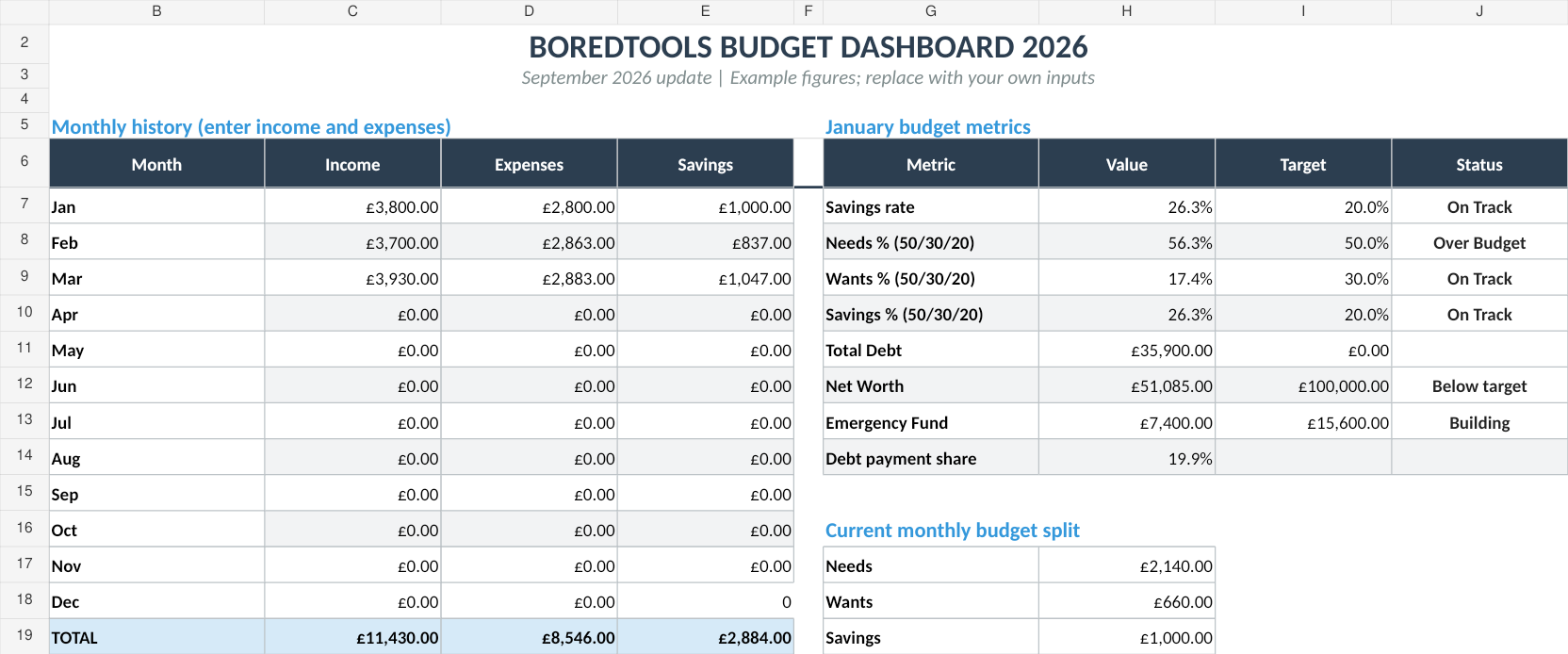
UK edition built for British finances. HMRC Self Assessment categories, council tax tracking, National Insurance (Class 2 and Class 4) calculations, ISA allowances, and GBP formatting throughout. US edition included with IRS tax brackets, 401(k) tracking, and USD formatting.
A more detailed spreadsheet with savings goals, debt tracking, a visual dashboard, and a yearly overview. Everything in the free version plus the ability to track progress over time.
Pros:
- One-time cost. Not a subscription eating into your budget every month
- Debt tracking built in (useful for UC advance repayments and priority debts)
- Savings goals with progress tracking. Even micro-savings targets feel tangible when you can see a bar filling up
- Yearly overview shows income patterns across months, essential for spotting trends on irregular income
- Dashboard gives a visual snapshot without scrolling through rows of numbers
Cons:
- Costs £7.99. And when you are on a low income, every pound matters, so this needs to earn its place
- Still requires manual entry
- More features means a slightly steeper learning curve than the free version
Verdict: Worth it if you have been using the free template for a couple of months and want to track debt repayment, savings progress, or income patterns over time. The yearly overview is particularly useful for zero-hours contract workers who need to see their income averaged across months. But start with the free version. Upgrade only when you know you will use the extra features.
Critical Features in a Budget Template for Low Income Households
Whatever system you use, these are the features that separate a helpful tool from a generic one that does not understand your situation.
Universal Credit Payment Tracking
UC is assessed on a monthly assessment period, but the payment date is fixed (usually 7 days after the end of your period). Your income during the assessment period affects the next payment. If you are on a zero-hours contract, a busy month at work can reduce your UC payment the following month. Which feels like being punished for earning more.
Your template needs to track: assessment period dates, reported earnings for each period, expected UC amount (use the EntitledTo calculator), actual payment received, and any deductions (advances, overpayments, third-party debts). This lets you predict lean months before they arrive.
Zero-Hours Contract Income Averaging
If your hours vary, a single month's income is meaningless for budgeting. You need a rolling 3-month or 6-month average. Track each month's actual income, calculate the average, and budget to the average. Not to last month's number and not to your best month.
For example: if your last six months of take-home were £980, £1,150, £870, £1,200, £950, and £1,100, your 6-month average is £1,042. Budget to that. In good months, the surplus goes to your buffer. In lean months, the buffer covers the gap.
Council Tax Reduction Awareness
Council Tax Reduction (CTR) is means-tested and administered by your local council, so rules vary by area. Some councils offer up to 100% reduction for working-age UC claimants; others cap it at 75% or 80%. CTR is separate from Single Person Discount. You may qualify for both. Your budget should reflect the reduced amount, not the full bill. If you have not applied, that line item is costing you money you do not need to spend.
Warm Home Discount and Energy Support
The Warm Home Discount (£150/year off your electricity bill) is applied automatically for Pension Credit recipients, but working-age people on low incomes may need to apply through their energy supplier during a specific window (usually October-December). Your budget should flag this as an annual task. Beyond that: prepayment meter customers now have the same price cap as direct debit customers, energy suppliers must offer payment plans if you are in debt, and local hardship funds through your supplier can write off energy debt in some cases.
Food and Community Resources
Know what is available: the Trussell Trust network (trusselltrust.org/get-help) and independent food banks (many no longer require a referral); community fridges (hubbub.org.uk/the-community-fridge) for free supermarket surplus food; Too Good To Go and Olio apps for discounted or free food from shops and neighbours. Nobody should have to rely on food banks in one of the world's richest countries. But knowing the resources exist means they are there when you need them.
Our Recommendation
Start with free. The goal is stability, not premium tools.
Today: Run the EntitledTo and Turn2us benefit calculators. This takes 15-20 minutes and is the single highest-value action in this guide. If it surfaces even one missed entitlement, everything else is a bonus.
This week: Download the Free Budget Tracker | Also on Sort & Keep and fill in your real numbers. Income from all sources (wages, UC, PIP, Child Benefit, whatever applies). Expenses, starting with survival essentials. See what is left.
This month: If you are on a zero-hours contract or irregular income, start tracking monthly earnings so you can build a rolling average. Three months of data is enough to start budgeting to the average instead of guessing.
Ongoing: Re-run benefit calculators in April and whenever circumstances change. Check for Warm Home Discount eligibility in October. Reapply for free school meals if your income changes. These are annual maintenance tasks that protect your income.
When you are ready: If you have been using the free template and want debt tracking, savings goals, and a yearly overview, the Budget Dashboard 2026 | Also on Sort & Keep (£7.99, one-time) is there as an upgrade path. But only move to it when the free version genuinely is not enough. Not before.
The numbers might be brutally tight. For many people reading this, they are. But knowing exactly where every pound goes, and making absolutely certain you are receiving every pound you are entitled to, is how you turn chaos into control. Not comfort. Not yet. But control. And control is where stability starts.
Related Reads
- The 50/30/20 Budget Rule: Free Template (the ratios need serious adapting at low income, but the framework is worth understanding)
- Debt Payoff Calculator: Snowball vs Avalanche
- Best Budget Spreadsheet Templates in 2026
Get free spreadsheet templates and updates. New templates, feature updates, and practical guides delivered to your inbox. No spam, unsubscribe anytime.
Subscribe free → | Already have a template? Download the free budget tracker or free meal planner. No email required.
Choose the right next step
Need a simple budget tracker spreadsheet? Start with the Free Budget Tracker. Use Budget Dashboard 2026 when you want budgets, debt, savings and net worth in one workbook. Choose the Complete Collection when several parts of life admin need sorting.