Budget Template for High Earners: Tax Optimisation & Budgeting
Budget template for high earners covering personal allowance taper, pension maximisation, and lifestyle inflation. Get the template.

From Sort & Keep, the maker of the linked templates. Our current product prices update with your selected currency. Worked examples and third-party prices keep their stated currency and date.
You broke through six figures. The salary is serious. The tax bill is worse. And somehow, despite earning more than 95% of the UK population, the savings account looks roughly the same as it did when you were on £55k. Welcome to the high-earner trap. And finding the right budget template for high earners is the first step out of it.
Here's a number that should bother you: roughly 60% of households earning over £100,000 report living payslip to payslip. Not because they're reckless. Because lifestyle inflation scales silently alongside income, and the UK tax system actively punishes the £100k-£125,140 bracket with an effective 60% marginal tax rate that most people don't even know exists until their accountant winces.
Earning £100k+ doesn't automatically mean financial health. It means higher stakes, more complex tax obligations, and a much wider gap between what you could be keeping and what you actually are.
Why Standard Budgets Fail High Earners
The 50/30/20 rule is a solid starting point for median earners. For someone on £120k, it's almost useless. Not because the principle is wrong, but because it ignores every mechanism that actually moves the needle at this income level.
The personal allowance taper (£100,000 - £125,140). For every £2 you earn above £100,000, you lose £1 of your £12,570 personal allowance. This creates a stealth 60% effective tax rate on income between £100k and £125,140. Standard budgets don't account for this. They'll tell you to allocate 50% to needs, blissfully unaware that HMRC is already taking 60p of every additional pound in that band. If you're earning £115k and not using salary sacrifice or pension contributions to stay below the threshold, you're handing the government roughly £3,700 more than you need to.
Pension annual allowance (£60,000). You can contribute up to £60,000 per year to pensions with tax relief. For high-rate taxpayers, that's 40% relief. Meaning a £60,000 contribution effectively costs you £36,000 in take-home terms. Even better: you can carry forward up to three years of unused allowance. A standard budget template has no concept of this.
Capital gains vs income. The CGT annual exemption is now just £3,000. If you're holding investments outside of ISAs and SIPPs, every gain above that threshold is taxed at 18% (basic) or 24% (higher rate) for most assets. Your budget needs to distinguish between income you earn and gains you realise. They're taxed completely differently.
Salary sacrifice optimisation. Swapping gross salary for employer pension contributions saves both Income Tax and National Insurance. At £120k, sacrificing £20k of salary into your pension saves roughly £8,600 in combined tax and NI, compared to taking the salary and making a personal contribution. Standard budgets treat your gross salary as a fixed number. It shouldn't be.
High Income Child Benefit Charge. If you or your partner earn over £60,000, Child Benefit is clawed back at 1% for every £200 above that threshold, fully gone at £80,000. For two children, that's £2,212.60 per year at stake. Your budget needs to model whether it's worth keeping the claim or surrendering it.
None of these are edge cases. They're the core financial mechanics of earning £100k+ in the UK. A budget that ignores them is a budget that costs you thousands.
The High-Earner Budget Framework
The standard approach. Income minus expenses equals savings. Doesn't work when the relationship between gross income and net spending is this complex. High earners need to budget in a specific order, because decisions earlier in the chain affect everything downstream.
Step 1: Tax-Efficient Income Structuring
Before you budget a single pound of spending, decide how your income should be structured. This means modelling:
- Salary sacrifice into pension to bring taxable income below £100,000 (recovering the personal allowance)
- Dividend vs salary split if you operate through a limited company
- Employer pension contributions vs personal contributions (employer contributions don't count toward your taxable income)
- Bonus sacrifice. Diverting annual bonuses directly into pension before they hit your payslip
For someone on £125,000 base salary, sacrificing £25,000 into pension brings taxable income to £100,000, recovers the full personal allowance, and avoids the 60% effective rate entirely. The "cost" is £25,000 locked into your pension. But you'd have lost roughly £15,000 of it to tax anyway.
Step 2: Pension Maximisation
Once you've set the salary sacrifice level, calculate remaining pension headroom. The £60,000 annual allowance includes employer contributions, salary sacrifice, and personal contributions. If your employer puts in £8,000 and you sacrifice £25,000, you have £27,000 of remaining allowance for personal contributions (with 40% tax relief on the portion that falls in the higher-rate band).
Check your carry-forward position too. If you didn't max out last year or the year before, those unused allowances stack. We've seen people contribute £120,000+ in a single year using carry-forward. Entirely legally, with substantial tax relief.
Step 3: Investment Allocation
After pension, fill your ISA (£20,000 annual allowance, entirely tax-free growth and withdrawals). Then consider:
- General Investment Account (GIA) for amounts above ISA limits, being mindful of the £3,000 CGT annual exemption
- VCT/EIS for higher-risk investments with 30% income tax relief (VCT) or 30% with CGT deferral (EIS)
- Lifetime ISA. Not available if you're over 40 or buying a property worth more than £450,000, but worth checking
Step 4: Lifestyle Budget
Only now do you set your actual spending budget. This is what's left after tax structuring, pension contributions, and investment allocation. For many high earners, this is the first time they've ever calculated this number honestly. And it's often lower than they assumed.
The lifestyle budget is where inflation control happens. Set a fixed monthly spending allowance and automate it into a separate current account. When it's gone, it's gone. This single mechanism. Separating spending money from earning money. Prevents more lifestyle inflation than any spreadsheet formula.
Step 5: Charitable Giving
Gift Aid extends your basic rate band by the gross value of donations. A £10,000 donation (grossed up to £12,500 with Gift Aid) means you pay 40% tax on £12,500 less of your income. A tax saving of £2,500 on top of the charity's £2,500 reclaim. If you're charitably inclined anyway, structuring it properly makes each pound go further.
Budget Template for High Earners: Options to compare
Tax optimisation, pension tracking, and lifestyle inflation control.
1. DIY Spreadsheet (Google Sheets / Excel)
Platform: Google Sheets or Excel
Price: Free
Best for: High earners who enjoy building financial models and want total control
A blank spreadsheet gives you unlimited flexibility, and if you're the kind of person earning £100k+, there's a decent chance you're comfortable with formulas. You can build a personal allowance taper calculator, pension carry-forward tracker, and salary sacrifice modeller. If you know what to build.
Pros:
- Completely free
- Unlimited customisation for complex tax scenarios
- Can model salary sacrifice vs personal pension contribution trade-offs
- Your data stays entirely private
Cons:
- Requires significant tax knowledge to build correctly
- Personal allowance taper calculations are easy to get wrong
- No error-checking. A broken formula silently costs you money
- Building a proper version takes 6-10 hours; maintaining it takes ongoing effort
Verdict: The ceiling is high, but so is the effort. If you know exactly what you're optimising for and enjoy the build, a DIY sheet is powerful. If you want something that works out of the box, look further down the list. Our free budget tracker (Sort & Keep) gives you a clean starting point for the expense tracking side.
2. Plum / Monzo / Revolut Built-In Budgets
Platform: Mobile apps with budgeting features
Price: Free (basic) to £5-£18/month (premium tiers)
Best for: Day-to-day spending tracking, not strategic tax planning
The fintech budgeting tools are genuinely good at tracking where your money goes. Round-up savings, category spending alerts, pot allocation. All useful for managing the lifestyle budget (Step 4 above). But they operate entirely in the post-tax world.
Pros:
- Automatic transaction categorisation
- Spending findings and trend tracking
- Real-time balance and budget notifications
- Good for enforcing the "separate spending account" discipline
Cons:
- Zero tax optimisation features. No personal allowance taper, no pension tracking
- No salary sacrifice modelling or dividend planning
- Can't model the difference between gross and net income structuring
- Designed for people whose financial complexity stops at "did I overspend on coffee"
Verdict: Use one of these for Step 4 only. The actual day-to-day spending control. They're excellent at that. But they're categorically the wrong tool for Steps 1-3, which is where most of the money is.
3. Cleo / YNAB. Behavioural Budgeting
Platform: Web + mobile (YNAB), mobile-first (Cleo)
Price: YNAB $14.99/month; Cleo free (basic) or £5.99/month (Plus)
Best for: Breaking spending habits and enforcing envelope budgeting
YNAB's zero-based budgeting method. Give every pound a job. Works at any income level. Cleo uses AI chat to guilt you about your Deliveroo habit. Both focus on the spending side of the equation.
Pros:
- YNAB's method genuinely changes spending behaviour
- Goal tracking for large purchases or savings targets
- YNAB handles variable income well. You budget what you have, not what you expect
- Strong community with shared strategies
Cons:
- YNAB is $14.99/month ($179.88/year). Expensive for a budgeting tool
- Neither handles UK tax complexity at all
- No pension, ISA, or salary sacrifice integration
- Cleo's "roast me" AI chat gets old quickly
- YNAB's learning curve is steep. Expect 2-4 weeks before it clicks
Verdict: YNAB is the best pure spending tool we've tested. If your problem is specifically lifestyle inflation. You earn well but can't explain where it goes. YNAB will find the leaks. But it won't tell you whether to salary sacrifice £20k or £25k. Pair it with a tax-focused planning tool.
4. Accountant + Spreadsheet Combo
Platform: Your accountant's advice + a shared planning spreadsheet
Price: £1,000-£3,000/year for a decent UK accountant; spreadsheet free
Best for: High earners with complex affairs (multiple income sources, limited companies, property income)
The reality: if you're earning £150k+ with a limited company, rental income, and investment portfolios, no consumer budgeting tool handles your situation. A good accountant builds the tax strategy; you build the budget around it.
Pros:
- Personalised tax advice covering your exact situation
- Annual tax planning meetings to adjust salary, dividends, and pension strategy
- They catch things no template ever will. Like MPAA triggers or tapered annual allowance above £260,000
- Peace of mind that the numbers are right
Cons:
- £1,000-£3,000/year minimum for a competent accountant
- They handle tax; they don't handle your spending budget
- Meetings are typically annual or quarterly. Not responsive to monthly changes
- Quality varies wildly; a bad accountant costs more than they save
Verdict: Not optional above £150k or with a Ltd company. But an accountant solves the tax question, not the budgeting question. You still need a tool that translates their advice into a monthly spending plan you actually follow.
5. Budget Dashboard 2026. Best Spreadsheet for Structured High-Earner Budgeting
Platform: Google Sheets
Price: £7.99 one-time
Best for: High earners who want a clean, structured budget that separates tax planning from lifestyle spending
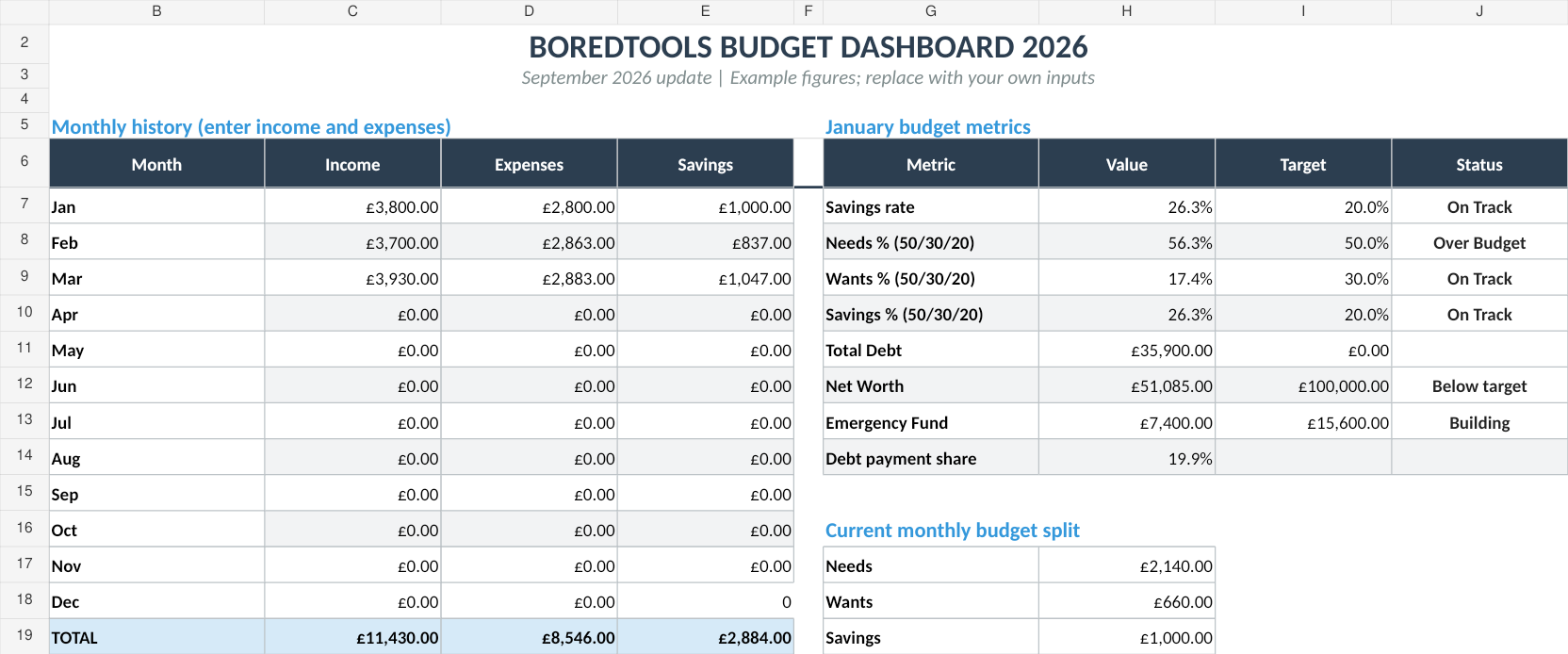
The Budget Dashboard 2026 (Sort & Keep) brings together income tracking, expense categorisation, net worth monitoring, and forward projections in a single Google Sheet. It's built around the principle that your budget should show you both where the money went and whether you're moving in the right direction.
UK edition built for British finances. HMRC Self Assessment categories, council tax tracking, National Insurance (Class 2 and Class 4) calculations, ISA allowances, and GBP formatting throughout. US edition included with IRS tax brackets, 401(k) tracking, and USD formatting.
Pros:
- Clean dashboard with monthly and annual views
- Net worth tracking alongside budget. Critical for high earners building wealth
- Expense categorisation that separates fixed obligations from discretionary spending
- One-time £7.99. No subscription, no vendor lock-in
- Works well as the "Step 4 spending plan" in the framework above
Cons:
- Doesn't include UK-specific tax calculators (personal allowance taper, salary sacrifice modelling)
- Manual data entry. No bank feeds
- You'll need to combine it with your accountant's advice for Steps 1-3
Verdict: For the lifestyle budget and net worth tracking side, this is the best spreadsheet option we've found at this price point. It won't replace your accountant for tax strategy, but it fills the gap that accountants don't cover. The actual monthly spending discipline. Pair it with the tax-efficient framework above and you've got both sides handled. Get the Budget Dashboard 2026 on Sort & Keep | Also on Sort & Keep.
Budget Template for High Earners: Features Checklist
Whatever tool you choose, here's what should be on or alongside it if you're earning £100k+:
Personal allowance taper calculator. Input your gross salary, see exactly how much personal allowance you lose, and calculate the effective tax rate on every pound between £100k and £125,140. This single calculation often saves £3,000-£5,000 per year.
Pension carry-forward tracker. You need to know your unused annual allowance from the previous three tax years. If you've been contributing £20,000/year to a £60,000 allowance, you're sitting on £120,000 of carry-forward. Potentially worth £48,000 in tax relief.
Salary sacrifice modeller. Compare take-home pay under different sacrifice levels. At £125k gross, sacrificing £25k leaves you with roughly the same take-home as earning £115k without sacrifice. But with £25k added to your pension instead of £10k lost to the 60% trap.
Dividend vs salary comparison. If you run a Ltd company, model the optimal salary/dividend split. For 2025/26, the most tax-efficient salary is typically £12,570 (the personal allowance) with the rest as dividends. Though this depends on your specific situation and corporation tax position.
Capital gains allowance usage. Track whether you've used your £3,000 annual CGT exemption. If you're holding investments in a GIA, consider bed-and-ISA strategies. Selling and rebuying inside an ISA to reset the gain.
ISA/SIPP allocation planner. Map out how to fill your £20,000 ISA and remaining pension allowance each tax year. Front-loading ISA contributions in April means more months of tax-free growth.
Price Comparison
| Tool | Price | Tax Optimisation | Pension Tracking | Lifestyle Budget | Net Worth |
|---|---|---|---|---|---|
| DIY Spreadsheet | Free | If you build it | If you build it | If you build it | If you build it |
| Fintech apps (Monzo etc.) | Free-£18/month | No | No | Yes | Limited |
| YNAB | $14.99/month | No | No | Yes | No |
| Accountant | £1,000-£3,000/year | Yes (strategy) | Yes (advice) | No | No |
| Budget Dashboard 2026 | £7.99 one-time | No (pair with accountant) | Manual tracking | Yes | Yes |
What You Should Actually Do
Here's the decision tree based on where you are:
"I earn £100k-£125k and I've never optimised my tax position." Start with the personal allowance taper. Talk to your employer about salary sacrifice into pension. This single move can save you £3,000-£7,500 per year. Use the Budget Dashboard 2026 (Sort & Keep) to build the spending side.
"I earn well but I genuinely don't know where the money goes." YNAB for 3 months to find the leaks. Once you understand your spending, switch to a spreadsheet for long-term tracking and build the tax framework around it.
"I have a Ltd company and multiple income sources." Get an accountant. Seriously. The ROI on a good accountant at this level is 5-10x their fee. Use a spreadsheet or the Budget Dashboard to manage the personal spending that falls out of their tax plan.
"I just want a solid budget tracker to get started." Our free budget tracker (Sort & Keep) handles the basics. Income, expenses, categories. Layer in the high-earner framework from this article as you go.
"I want to understand my net worth trajectory, not just monthly spending." The Budget Dashboard includes net worth tracking alongside the budget. See our full guide on how to track your net worth in Google Sheets for the method.
The Bottom Line
The irony of high earning is that the stakes of bad budgeting are higher, not lower. At £50k, a sloppy budget means you save less than you could. At £120k, a sloppy budget. Combined with ignorance of the personal allowance taper, pension optimisation, and salary sacrifice. Can cost you £10,000-£15,000 per year in avoidable tax alone. Before you even count the lifestyle inflation.
The framework is straightforward: structure your income tax-efficiently first, maximise pension contributions second, fill your ISA third, set a fixed lifestyle budget fourth, and track everything. The tools don't need to be expensive. A good accountant for strategy. A clean spreadsheet or the Budget Dashboard 2026 (Sort & Keep) for execution. And the discipline to treat your spending allowance as a real constraint, not a suggestion.
You didn't earn £100k+ by accident. Don't let the tax system and lifestyle creep take half of it by default.
Related Reads
- Budget Template for Retirees: Fixed Income Budget Tracker
- FIRE Spreadsheet: Calculate Your Financial Independence Number
- How to Track Your Net Worth in Google Sheets
- Best Budget Spreadsheet Templates in 2026
Get free spreadsheet templates and updates. New templates, feature updates, and practical guides delivered to your inbox. No spam, unsubscribe anytime.
Subscribe free → | Already have a template? Download the free budget tracker or free meal planner. No email required.
Choose the right next step
Need a simple budget tracker spreadsheet? Start with the Free Budget Tracker. Use Budget Dashboard 2026 when you want budgets, debt, savings and net worth in one workbook. Choose the Complete Collection when several parts of life admin need sorting.