Budget Template for Homeowners: Mortgage, Maintenance & Hidden Costs
Budget template for homeowners covering mortgage payments, maintenance sinking funds, and hidden costs first-time buyers miss. Get the template.

From Sort & Keep, the maker of the linked templates. Our current product prices update with your selected currency. Worked examples and third-party prices keep their stated currency and date.
You saved the deposit. Survived the solicitor. Paid stamp duty, surveys, the removal van, and an inexplicable £300 "bank transfer fee" nobody warned you about. You got the keys. You're a homeowner. Then the boiler breaks.
The average UK first-time buyer burns through £2,000 to £5,000 in surprise costs during year one. On top of the mortgage, stamp duty, and solicitor fees they already planned for. A dripping tap turns into a replumbed bathroom. The "cosmetic" damp patch becomes an £1,800 remediation job. The previous owners kept the garden presentable because they were paying £400 a year for a gardener. That's your problem now.
None of this is unusual. Nobody tells you to budget for it, that's all. The mortgage approval process checks whether you can afford the monthly payment. Not whether you can afford the monthly payment plus buildings insurance plus boiler cover plus the window the estate agent called "characterful" and the surveyor called "approaching end of life."
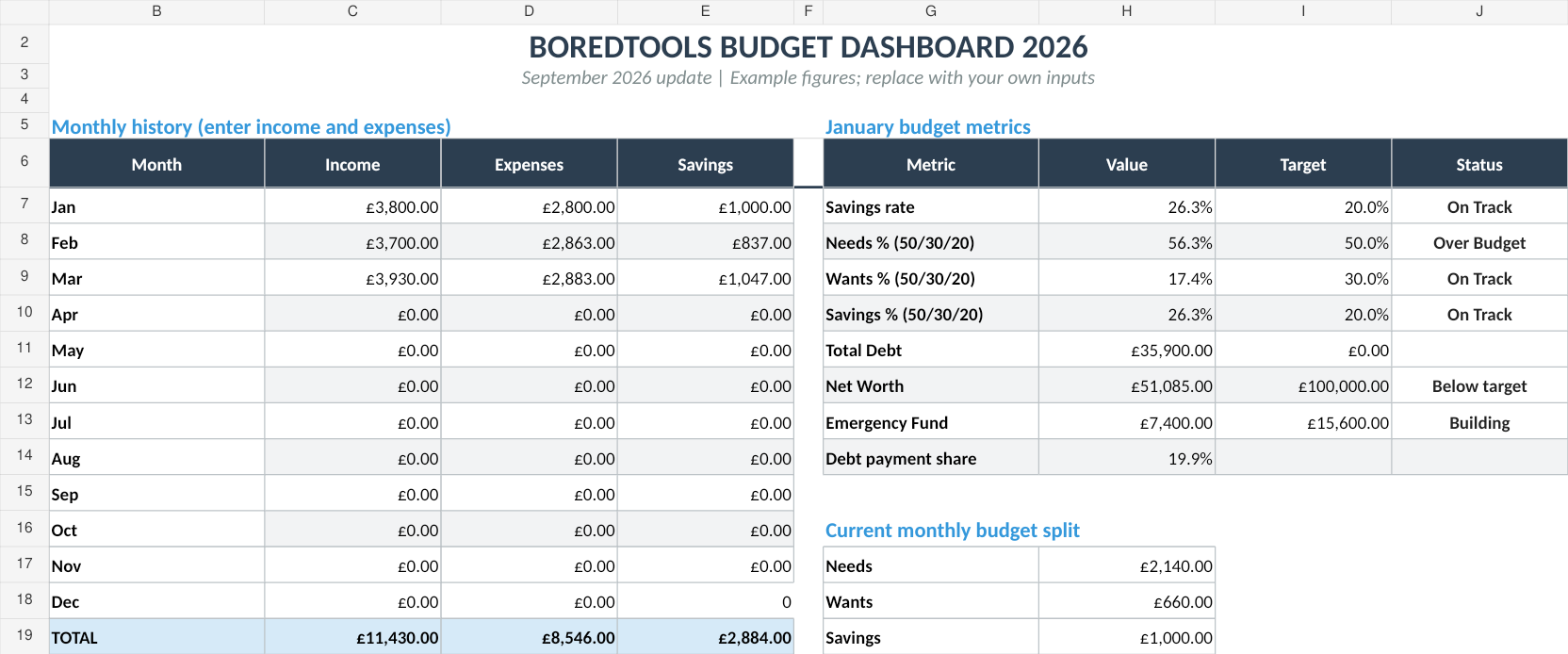
The Budget Dashboard 2026 is built for exactly this. One Google Sheet covers your mortgage, sinking fund, improvement savings, and household budget together. Get it on Sort & Keep for £7.99 →
Why You Need a Budget Template for Homeowners
If you rented before buying, you had a beautifully simple housing cost: rent. One number. Maybe utilities on top. The leaky roof, the broken dishwasher, the rotting fence. Your landlord's problem.
Homeownership replaces that one number with about fifteen:
- Mortgage payment. The obvious one, but it has moving parts if you're on a variable or tracker rate
- Buildings insurance. Mandatory with a mortgage; typically £150 to £400 per year
- Contents insurance. Optional but unwise to skip; £100 to £300 per year
- Council tax. £1,200 to £3,500 per year depending on band and location, and it went up again in April 2026
- Service charges and ground rent. If you own a leasehold flat, expect £1,500 to £4,000 per year, sometimes more
- Boiler and heating cover. £10 to £30 per month, or self-insure and hope
- Home emergency cover. Burst pipes, electrical failures, pest control
- Garden maintenance. Tools, lawn care, or a gardener at £30 to £50 per visit
- Windows, doors, roof, guttering. Gutter cleaning runs £75 to £150 twice a year; timber frames need painting every three to five years
- Appliance replacement. Boilers last 10 to 15 years, kitchens 15 to 20, bathrooms 15 to 25
- Energy bills. Typically higher than a flat, especially in older houses
The 50/30/20 rule works as a starting framework, but most homeowners find "needs" swallows 55 to 65% of income once all housing costs land. Your renter budget assumed housing was 30%. Your homeowner budget needs 40 to 50%. Before the surprises.
The Homeowner Budget Framework
The approach that works is layered. Instead of one "housing" line item, split it into four buckets.
Layer 1. Fixed Housing Costs (non-negotiable)
These come out first, every month, no exceptions:
| Expense | Typical Monthly (UK) |
|---|---|
| Mortgage | £800 to £1,500 |
| Buildings insurance | £15 to £35 |
| Contents insurance | £10 to £25 |
| Council tax | £100 to £290 |
| Service charge (leasehold) | £125 to £330 |
| Ground rent (leasehold) | £20 to £50 |
| Life insurance (if required by lender) | £15 to £40 |
Total typical range: £950 to £2,270 per month depending on property value, location, and tenure. Know this number to the penny. It's your baseline.
Layer 2. Maintenance Sinking Fund (the one everyone skips)
Standard rule of thumb: set aside 1% of your property's value per year for maintenance. For a £250,000 house, that's £2,500 per year, or roughly £210 per month.
That sounds like a lot when nothing's broken. It sounds like nothing when the roof needs replacing (£5,000 to £12,000) or the boiler dies in January (£2,500 to £4,000 installed). Think of it as self-insurance. The pot grows in good years, and you draw from it instead of reaching for a credit card when something fails.
How to calculate yours:
- Property value: £250,000
- Annual maintenance fund: £2,500 (1%)
- Monthly set-aside: £208
If your property is older (pre-1950), push this to 1.5%. New build under NHBC warranty? Drop to 0.5% for the first two years and increase after. A sinking funds spreadsheet makes tracking this dead simple, one tab per fund, balance visible at a glance.
Layer 3. Home Improvement Savings
Maintenance keeps the house standing. Improvements make it worth more, or at least more liveable. New kitchen, garden landscaping, loft conversion, double glazing. These are projects you choose, not ones forced on you.
Budget them separately from maintenance so one doesn't eat the other. A reasonable target is £100 to £300 per month. If you're saving for a £12,000 kitchen, that's 40 months at £300. Better to know that now than to slap it on a 0% credit card and hope.
Layer 4. Emergency Fund
This isn't the maintenance fund. This is the "I lost my job and still have a mortgage to pay" fund. Standard advice is three to six months of expenses. For homeowners, push toward six. Your fixed costs are higher and you can't just hand in notice on a mortgage.
If your total essential expenses are £2,200 per month, your target is £13,200. Feels intimidating? Start with one month and build.
The Budget Dashboard 2026 handles all four layers in one Google Sheet. Savings goals for your sinking fund, a debt tracker for your mortgage with overpayment history, and a net worth tab that includes property value. Grab it for £7.99 on Sort & Keep →
Budget Templates and Tools for Homeowners: Options to compare
1. DIY Google Sheets / Excel Spreadsheet
Platform: Google Sheets or Excel
Price: Free
Best for: Homeowners who want complete control and enjoy building spreadsheets
You can build the entire four-layer system in a blank spreadsheet. We did it. Two hours to get something functional with tabs for fixed costs, sinking fund, improvement savings, and a monthly overview.
Pros:
- Completely free with total flexibility
- No vendor lock-in; your data stays with you
- Can add mortgage overpayment calculators, energy tracking, anything you need
Cons:
- Two hours of setup before you can start using it
- Formulas break when you add rows carelessly
- No built-in charts unless you build them manually
- Maintaining it becomes yet another household task
Verdict: Works if you find spreadsheet-building satisfying. Most homeowners start here, keep it up for three months, then stop.
2. Property Management Platforms (Goodlord, Arthur, Landlord Studio)
Platform: Web app
Price: £5 to £30 per month
Best for: Landlords, not owner-occupiers
These tools are built for rental properties. Tenant tracking, rent collection, tax-deductible expense logging. If you're a buy-to-let investor, excellent. If you live in your own home, they solve the wrong problem. No personal budgeting, no sinking fund logic, no household expense tracking.
Verdict: Skip unless you also own rental property.
3. YNAB (You Need A Budget)
Platform: Web app and mobile
Price: $14.99 per month or $99 per year
Best for: Homeowners who want envelope budgeting with automatic bank syncing
YNAB's envelope method maps well to homeowner budgeting. Create envelopes for each of the four layers, fund them monthly, draw from the sinking fund when the boiler breaks. It actually works.
Pros:
- Envelope system fits the sinking fund approach naturally
- Automatic bank syncing cuts down manual entry
- Set a £2,500 annual maintenance target and it calculates monthly contributions
- Large community with homeowner-specific templates
Cons:
- $14.99 per month ($180 per year) is real money. That goes in the sinking fund
- Less flexible for custom calculations like mortgage overpayment scenarios
- No homeowner-specific features: no mortgage tracker, no property value monitoring
- Your data lives in their cloud
Verdict: Best app-based approach to homeowner budgeting. But at £150+ per year, you're paying a subscription for a tool that still won't do mortgage overpayment calculations or energy bill tracking. Pair it with a spreadsheet for those and the total cost starts to hurt.
4. Aspire Budget (Google Sheets)
Platform: Google Sheets
Price: Free
Best for: Homeowners who want YNAB's envelope method without the subscription
Aspire is an open-source Google Sheets template that replicates YNAB's envelope approach. Create categories, allocate money monthly, track spending against each envelope.
Pros:
- Genuinely free with no catch
- Envelope budgeting works well for sinking funds
- Dashboard with charts and monthly breakdowns
- Active Reddit community for support
- You can customise it to add homeowner-specific categories
Cons:
- Setup takes 30 to 45 minutes and the learning curve is real
- No homeowner-specific features out of the box; you have to build them
- Can feel sluggish on mobile
- All manual entry; no bank feeds
Verdict: Solid free option if you'll invest the setup time. The downside: you're bolting homeowner features onto a general-purpose tool. It works, but it's not built for this.
5. Sort & Keep Budget Dashboard 2026
Platform: Google Sheets
Price: £7.99 one-time (Sort & Keep)
UK edition built for British finances. HMRC Self Assessment categories, council tax tracking, National Insurance (Class 2 and Class 4) calculations, ISA allowances, and GBP formatting throughout. US edition included with IRS tax brackets, 401(k) tracking, and USD formatting.
Best for: Homeowners who want budget, debt, savings, and net worth tracking in one place
Full disclosure: we built this. It handles the four-layer framework well because it combines monthly budgeting with savings goal tracking, joint budget planning, and net worth monitoring in a single sheet.
Set up savings goals for your sinking fund, improvement fund, and emergency fund. Add your mortgage as a debt with overpayment tracking. Fixed housing costs go into the monthly budget categories. Everything updates on the dashboard.
Pros:
- Monthly budget, savings goals, debt tracker, and net worth in one sheet
- Savings goal tracking nails the sinking fund use case: set £2,500 target, fund monthly, watch progress
- Mortgage sits in the debt tracker with balance and payment history
- Net worth tab includes property value as an asset (update annually or after improvements)
- £7.99 one-time, no subscription
- Setup takes under 10 minutes
Cons:
- Google Sheets only. No Excel version
- No dedicated mortgage overpayment calculator (you can build one in an extra tab)
- Manual data entry; no bank feeds
Verdict: Best value for homeowner budgeting. Having your mortgage, property value, and household budget in one spreadsheet means you see the full picture. Get the Budget Dashboard 2026 on Sort & Keep →
Features to Look For in a Budget Template for Homeowners
Whatever tool you choose, here are the features that separate a homeowner budget from a generic one.
Mortgage Overpayment Calculator
Most UK mortgages allow overpayments of up to 10% of the outstanding balance per year without early repayment charges. On a £200,000 mortgage at 4.5% over 25 years, overpaying £100 per month saves roughly £16,000 in interest and cuts four years off the term. Your budget template should model this. How much can you afford to overpay, and is the money better against the mortgage or sitting in the sinking fund?
Maintenance Sinking Fund Tracker
Not just a savings goal. A tracker showing your sinking fund balance against the 1% annual target, with a log of withdrawals. When you can see the fund covered a £450 gutter repair, a £180 drain unblocking, and a £95 chimney sweep this year, you stop resenting the monthly contribution.
Energy Bill Comparison
For homeowners, energy efficiency is something you can actually change. Track monthly gas and electricity against your EPC rating. Spending £250 per month in a Band D property? Loft insulation (£300 to £500) saves £150 to £300 per year. Cavity wall insulation (£500 to £1,500) saves £100 to £400 per year. Your budget template should help you calculate those payback periods.
Council Tax Band Checker
Roughly 400,000 UK properties sit in the wrong council tax band. If you're in Band D paying £2,100 per year but should be in Band C at £1,870, that's £230 per year. £5,750 over 25 years. Your budget template should at least prompt you to check.
Home Improvement ROI Tracker
Not all improvements pay off equally. A new kitchen returns 60 to 80% of its cost at sale. A loft conversion returns 70 to 90%. A swimming pool returns almost nothing in the UK and bumps your insurance premium. Track spend against estimated value added so you're making informed calls, not emotional ones.
Stamp Duty Calculator
Less relevant for ongoing budgeting, more useful if you're planning to move. Current rates (2026): 0% on the first £125,000, 2% on £125,001 to £250,000, 5% on £250,001 to £925,000. First-time buyer relief applies up to £625,000. Your template should calculate this so moving costs are part of long-term financial planning, not a last-minute surprise.
Price Comparison
| Tool | Price | Sinking Fund | Mortgage Tracking | Savings Goals | Net Worth |
|---|---|---|---|---|---|
| DIY Spreadsheet | Free | Manual | Manual | Manual | Manual |
| Property Mgmt Platforms | £5 to £30/month | Some | No | No | No |
| YNAB | $14.99/month | Yes (envelopes) | No | Yes | No |
| Aspire Budget | Free | Yes (envelopes) | No | Yes | No |
| Sort & Keep Dashboard 2026 | £7.99 one-time | Yes | Yes (debt tracker) | Yes | Yes |
Our Recommendation
Here's the decision tree:
"I've never budgeted before and I just bought a house." Start with the free budget tracker. Set up the four layers above. Get into the habit before spending money on tools.
"I want one spreadsheet for my mortgage, sinking fund, improvement savings, and household budget." The Budget Dashboard 2026 at £7.99 handles all of it in one Google Sheet. Add your property value to the net worth tab, your mortgage to the debt tracker, and your sinking fund as a savings goal.
"I prefer an app with bank syncing." YNAB. Set up envelopes for each layer. Accept that you'll still need a spreadsheet for mortgage overpayment modelling.
"I want free and I'll invest the setup time." Aspire Budget. Customise the categories for homeownership. Expect 45 minutes of configuration.
"I have a complex situation. Multiple properties, leasehold charges, shared freehold." You probably need an accountant alongside your personal budget template. Start with household finances and let the accountant handle property-specific tax.
Whatever you choose, the sinking fund is the piece you can't skip. The boiler will break. The roof will leak. The fence will blow down. The only question is whether you've got £2,000 sitting in a dedicated pot when it happens, or whether you're reaching for a credit card at 24.9% APR.
Get the Budget Dashboard 2026 for £7.99 →
Related Reads
- Budget Template for Couples: How to Manage Money Together
- Sinking Funds Spreadsheet Template
- Savings Goal Tracker Spreadsheet
- Best Budget Spreadsheet Templates in 2026
Get free spreadsheet templates and updates. New templates, feature updates, and practical guides delivered to your inbox. No spam, unsubscribe anytime.
Subscribe free → | Already have a template? Download the free budget tracker. No email required.
Choose the right next step
Need a simple budget tracker spreadsheet? Start with the Free Budget Tracker. Use Budget Dashboard 2026 when you want budgets, debt, savings and net worth in one workbook. Choose the Complete Collection when several parts of life admin need sorting.