Budget Template for Military Families: Allowances & Deployments
Budget template for military families covering allowances, deployments, SFA charges, and frequent postings. Get the template.

From Sort & Keep, the maker of the linked templates. Our current product prices update with your selected currency. Worked examples and third-party prices keep their stated currency and date.
Your payslip says one thing. Your bank balance says another. And between the base pay, the X-Factor supplement at 14.5%, the Local Overseas Allowance that appeared when you moved to Germany, the Get You Home travel claims that take six weeks to land, and the SFA charge that bears no resemblance to what the quarter would cost on the open market -- you're left staring at JPA wondering where the money actually went.
If you've been looking for a budget template for military families that actually accounts for how military pay works, you've probably already discovered that civilian budgeting tools assume one salary, one address, and a partner with a stable career. None of those apply when you're posted every two to three years, your housing situation changes at someone else's discretion, and your other half has to restart their career in a new city with no notice.
We've tested every budgeting approach we could find against the reality of UK military finances. Most break within the first posting order. Here's what works, what doesn't, and how to build a budget that treats the military pay system as it actually is rather than pretending it's a normal salary.
Why Civilian Budget Templates Break for Military Families
The 50/30/20 rule is a decent starting point for someone with a stable income and a fixed address. For military families, it falls apart in four specific ways.
Your income isn't one number -- it's a stack of allowances. An OF-2 Captain on the 2026 pay scale takes home roughly £44,000 base salary plus X-Factor (14.5% of base, currently around £6,400). Then there's Longer Separation Allowance at £9.88-£18.70/day during deployments, Get You Home (Overseas) at up to £356 per trip, and potentially Disturbance Allowance of £2,725-£5,449 per posting. Some of these are taxable, some aren't. Some appear for six months and vanish. A budget built around a single monthly income figure is wrong before you finish filling it in.
Your housing cost changes with every posting. Service Families Accommodation charges range from roughly £180 to £650/month depending on grade and band -- well below market rent for equivalent properties. But move to a posting where no SFA is available, and suddenly you're renting privately at £1,200/month in Wiltshire or claiming contributions toward rent. Buy a house using Forces Help to Buy (up to £25,000 interest-free), and you add a mortgage to the picture while potentially receiving no housing allowance at all. A budget with a fixed "Rent/Mortgage" line is useless when that number changes every two years.
Deployments change both sides of the equation. Income goes up -- you gain Longer Separation Allowance and potentially Operational Allowance (tax-free, around £29.02/day). But expenses shift too. The deployed partner's food and accommodation are provided, so household grocery and utility costs drop. Meanwhile, the partner at home may spend more on childcare, travel to family for support, and maintaining the household solo. The net effect on the budget can go either direction, and it's different every deployment.
Partner employment gets disrupted every posting cycle. The military spouse employment gap is well documented. Moving every two to three years means your partner is perpetually the new hire, often unable to build seniority, qualify for promotions, or sustain self-employment clients. Average earnings for military spouses are significantly lower than civilian equivalents. Your household budget needs to treat partner income as variable, not fixed -- because it is.
The Military Family Budget Framework
Before picking a tool, you need the right structure. Here's the framework that actually maps to how military pay works.
Step 1: Map Your Full Income Stack
Don't start with your net pay. Start with every component separately.
| Component | Monthly | Taxable? | Guaranteed? |
|---|---|---|---|
| Base Pay (rank + increment) | £3,667 | Yes | Yes |
| X-Factor (14.5%) | £531 | Yes | Yes |
| Longer Separation Allowance | £561 (at £18.70/day) | No | Only during qualifying separation |
| Get You Home (Overseas) | ~£89 (one trip/month) | No | Only when posted overseas |
| Disturbance Allowance | £227-£454 (amortised) | No | Only on posting |
| Partner Income | £1,200 | Yes | Variable |
| Total (deployment month) | ~£6,275 | ||
| Total (non-deployment) | ~£5,398 |
The difference between a deployment month and a normal month can be £800+. A budget that uses one number for both is lying to you.
Step 2: Separate Guaranteed from Variable Income
Your base pay plus X-Factor is guaranteed. Everything else -- allowances, partner income, claims -- is variable. Build your essential expenses (housing, food, insurance, transport) against guaranteed income only. Variable income funds savings goals, debt payoff, and discretionary spending. This way, when an allowance stops or your partner is between jobs, the essentials are still covered without panic.
Step 3: Model Your Housing Cost Correctly
Military housing falls into three categories, and your budget needs to handle whichever you're in right now while being ready for the switch.
| Scenario | Monthly Cost | Notes |
|---|---|---|
| SFA (Service Families Accommodation) | £180-£650 | Band-dependent, well below market |
| Private Rental (with RHPP/rental support) | £800-£1,400 | Varies wildly by posting area |
| Owned (Forces Help to Buy) | £700-£1,200 mortgage | Plus £25k FHTB loan repayment after year 1 |
If you're in SFA at £320/month, the temptation is to budget as though that's your permanent housing cost. It isn't. When you leave the military or get posted somewhere without SFA, you'll face market-rate housing. We recommend budgeting as though your housing costs £800/month minimum -- live on the SFA amount, and save the £480 difference toward a deposit or transition fund.
Step 4: Build a Deployment Adjustment Layer
Create two budget profiles: "home" and "deployed." Income goes up (add LSA, Operational Allowance). Some expenses drop (groceries, utilities, transport for the deployed partner). Others rise (childcare, parcels, phone costs, solo household maintenance). A six-month deployment with net savings of £300-500/month is realistic if you plan for it -- £1,800-£3,000 straight into a transition fund or Forces Help to Buy deposit.
Step 5: Plan for Transition from Day One
Whether you leave at 4 years or 22, the transition to civilian life brings financial shocks: loss of subsidised housing, loss of allowances, and a job market that may not value your rank the way you'd hope. The AFPS 2015 pension doesn't pay until age 60. Start a "Transition Fund" line in your budget from your first posting. Even £100/month for 10 years gives you a meaningful cushion.
Budget Template for Military Families: Options to compare
1. MoneyForce / Forces MoneyPlan
Platform: Web (via the Royal British Legion / MoneyForce partnership)
Price: Free
Best for: Service personnel wanting a military-specific starting point
MoneyForce provides free financial guidance for the Armed Forces community, including budget planners that understand allowances and military pay structures. The tools are basic but they speak the right language -- they know what LSA is, they understand SFA charges, and they don't assume your housing situation is permanent.
Pros:
- Free and specifically designed for military families
- Understands allowance structures and military pay terminology
- Access to trained financial coaches who know the military system
Cons:
- Very basic budget tool -- no tracking over time, no deployment profiles
- No spreadsheet export or ongoing tracking capability
- More of a one-off assessment than a living budget
Verdict: Excellent starting point for understanding your financial position, especially if you've never budgeted before. But it's a snapshot, not a system. Use it to establish your baseline, then move to a tool that can track month-to-month.
2. YNAB (You Need A Budget)
Platform: Web + mobile
Price: $14.99/month ($99/year)
Best for: Military families who want the best budgeting methodology and don't mind paying for it
YNAB's envelope method -- every pound gets a job -- is genuinely the best budgeting framework we've tested. For military families, custom categories mean you can build an allowance tracker, deployment profile, and transition fund all within the system. The "Roll With The Punches" philosophy handles income volatility well. YNAB has a large military following in the US, and it works equally well for UK forces.
Pros:
- Best-in-class budgeting methodology (envelope/zero-based)
- Custom categories handle any allowance structure
- Bank syncing available for UK accounts (most major banks)
- Mobile app for tracking on the go
Cons:
- $14.99/month is £12/month -- £144/year is steep
- No military-specific features or terminology
- Doesn't handle deployment profiles natively (you manually adjust categories)
- Learning curve is real -- takes 2-3 months to click
Verdict: If you can stomach the subscription, YNAB is the most solid ongoing budgeting tool available. But at £144/year, it needs to save you more than it costs -- and if you're disciplined enough to use YNAB properly, you might be disciplined enough to use a spreadsheet.
3. DIY Google Sheets (Custom Military Build)
Platform: Google Sheets
Price: Free
Best for: Spreadsheet-comfortable families who want total control
Building your own military budget spreadsheet gives you complete flexibility -- model every allowance, create deployment toggles, track SFA vs. Private rental side by side. We built one. It took about five hours and worked brilliantly for three months, then one partner stopped updating it because entering expenses on a phone in Google Sheets is miserable.
Pros:
- Free and infinitely customisable
- Can model any military-specific scenario
- Shareable with partner via Google account
- No subscription, no vendor risk
Cons:
- Five-plus hours to build properly
- Google Sheets on mobile is painful for daily expense entry
- Formulas break when you add rows without updating ranges
- Both partners need to maintain it -- if one stops, the data is incomplete
Verdict: Most powerful option if you have the patience. If you just want something that works, it's a time sink. Our free budget tracker (Sort & Keep) saves the first two to three hours -- add military tabs on top.
4. Emma / Plum / Snoop (UK Banking Apps)
Platform: Mobile (iOS + Android)
Price: Free tiers available; premium £5-10/month
Best for: Families who want automated tracking with minimal manual input
These UK-focused fintech apps connect to your bank accounts and automatically categorise spending. Emma spots subscriptions, Plum automates small savings transfers, and Snoop analyses spending patterns. They work with military bank accounts and the automation means no manual entry.
Pros:
- Automatic transaction categorisation (minimal manual effort)
- UK bank integration works with forces banking (HSBC, Lloyds, etc.)
- Good at spotting wasteful subscriptions
- Free tiers are genuinely useful
Cons:
- No understanding of military allowances (everything is just "income")
- Cannot separate taxable from non-taxable income components
- No deployment profiles, housing comparison, or transition planning
- Categorisation accuracy is hit-and-miss (military-related transactions often miscategorised)
Verdict: Useful as a spending tracker bolted onto a proper budget, but not a budgeting tool on their own. Emma is the best of the three. None will help you plan for a posting or prepare for transition. Pair with a spreadsheet for the strategic layer.
5. Pre-Built Budget Spreadsheet with Military Layer
Platform: Google Sheets / Excel
Price: Free to £7.99 one-time
Best for: Military families who want structure without building from scratch
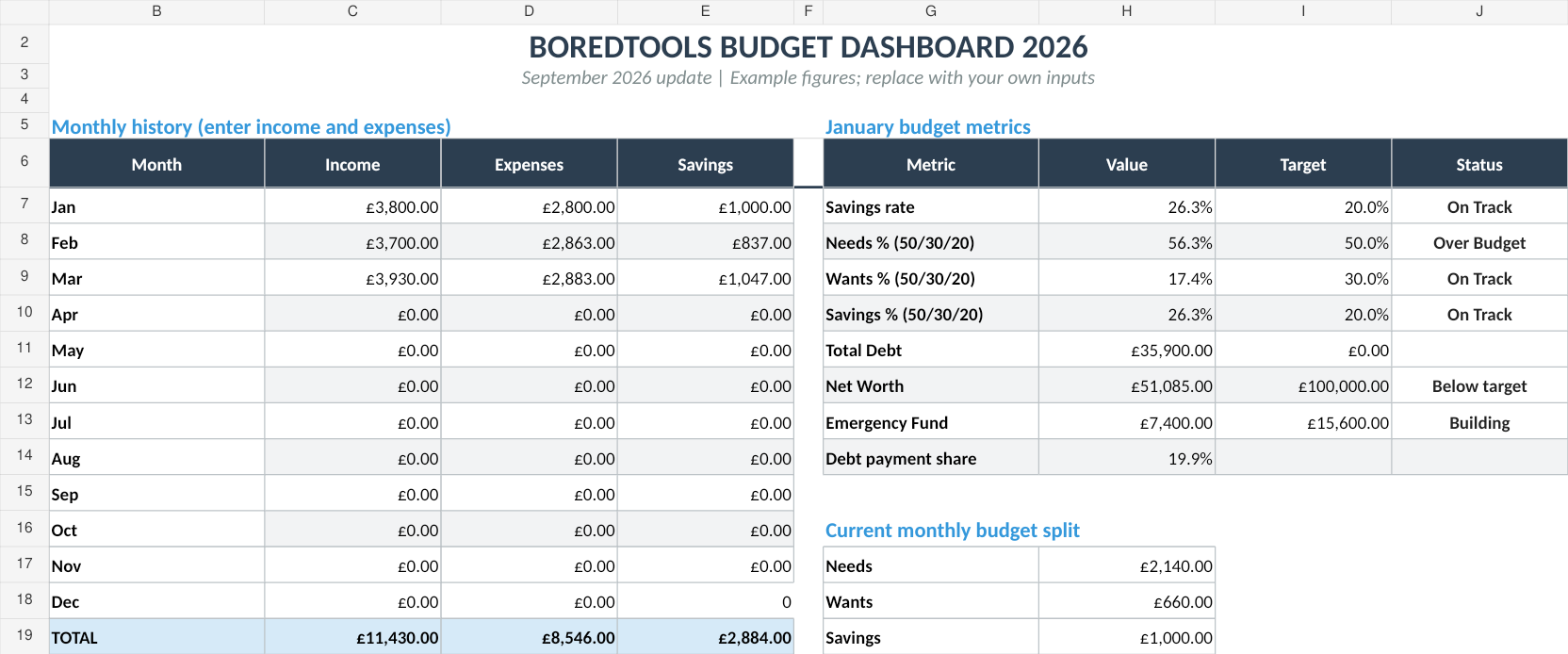
This is what we recommend for most military families. The Budget Dashboard 2026 (Sort & Keep) at £7.99 handles multiple income sources, categorised expenses, savings goals, and monthly/yearly views. Add an allowance tracker tab, a deployment budget profile, and a housing comparison sheet. Forty-five minutes versus five hours from scratch.
UK edition built for British finances. HMRC Self Assessment categories, council tax tracking, National Insurance (Class 2 and Class 4) calculations, ISA allowances, and GBP formatting throughout. US edition included with IRS tax brackets, 401(k) tracking, and USD formatting.
Pros:
- Pre-built structure saves hours of setup
- One-time cost, no subscription
- Full control to add military-specific features
- Works on Google Sheets (accessible from any device, shareable with partner)
Cons:
- Requires some spreadsheet comfort for the military customisation layer
- No bank syncing (manual entry or import)
- Not military-specific out of the box -- you add that layer
Verdict: Best balance of cost, structure, and military relevance. The Budget Dashboard 2026 (Sort & Keep) gives you income tracking, expense categories, and savings goals as a foundation. Add tabs for your allowance stack, deployment profile, and transition fund. Or start free with our budget tracker (Sort & Keep) and build the military layer from there.
Budget Template for Military Families: Features You Need
Whatever tool you choose, make sure it covers these -- natively or through customisation.
Allowance Tracker
Log every allowance with its daily/monthly rate, taxable status, start date, and expected end date. At minimum: LSA (£9.88-£18.70/day, tax-free, stops when separation ends), GYH (up to £356/process overseas, claim-based so track submitted vs. Paid), LSAP (one month's salary advance, repaid over 12 months), and Disturbance Allowance (£2,725-£5,449 per posting, one-off). A simple table updated monthly prevents the "I thought we were still getting that" problem.
SFA Charge vs. Private Rental Comparison
Build a comparison sheet showing your SFA charge alongside equivalent private rental in the same area. This shows the housing subsidy value (often £500-800/month) and prepares you for the cost shock when you leave service. Include council tax on both sides -- SFA occupants pay it directly.
Deployment Income and Expense Calculator
A toggle that shows your household budget in two states: partner at home, partner deployed. Input deployment allowances, remove the deployed partner's personal expenses, adjust groceries and utilities downward, add deployment-specific costs (parcels, phone credit, childcare). Your net monthly position in both states should be visible so there are no surprises when the deployment order arrives.
Forces Help to Buy Tracker
Up to £25,000 interest-free toward a first property. Repayments start from month 13 at 1/120th of the loan (full £25k = £208.33/month for 10 years). Track: original loan, repayments made, remaining balance, and the monthly JPA deduction. This comes off your pay, not your bank account -- easy to forget until the payslip arrives.
Resettlement and Transition Fund Planner
Start tracking this from year one, not year twelve. A simple calculator showing: target transition fund (we recommend six months of civilian-equivalent expenses), current balance, monthly contribution, and projected date you'll hit the target. Factor in loss of subsidised housing, loss of allowances, and the gap between your last day of service and your first civilian payday.
Partner Career Gap Impact
Military spouses face a well-documented earnings penalty from frequent moves. If your partner earns £1,200/month but could earn £2,000/month with career continuity, that's £9,600/year your household absorbs. Track this explicitly -- not to assign blame, but to inform decisions about unaccompanied postings, buying a house in one location, and valuing your partner's career alongside the serving partner's pension.
Price Comparison
| Approach | Price | Military Allowance Tracking | Deployment Profiles | Transition Planning | FHTB Tracker |
|---|---|---|---|---|---|
| MoneyForce | Free | Partial | No | Basic | No |
| YNAB | £144/year | Manual (custom categories) | Manual | Manual | Manual |
| DIY Google Sheets | Free | Full (you build it) | Full | Full | Full |
| UK Banking Apps | Free-£120/year | No | No | No | No |
| Budget Dashboard + military layer | £7.99 one-time | Manual (added tabs) | Manual | Manual | Manual |
What We Actually Recommend
Here's the setup that works for most military families.
For the foundation: The Budget Dashboard 2026 (Sort & Keep) at £7.99. It handles the core budgeting -- income tracking, expense categories, savings goals, and monthly views. The multiple income source feature maps well to the allowance stack.
For the military layer: Add three tabs to the Dashboard -- an Allowance Tracker with rates and end dates, a Deployment Profile modelling both budget states, and a Transition Fund tracker. About 45 minutes of customisation.
For daily tracking: Emma (free tier) connected to your bank accounts. Don't rely on it for budgeting -- use it as a spending feed you reconcile against the spreadsheet monthly.
For the starting point: Our free budget tracker (Sort & Keep) gets you a working template immediately. Add the military tabs and upgrade to the Dashboard later if you want the full feature set.
For couples: Read our couples budget template guide for the proportional split framework, then layer military adjustments on top.
Total cost: $7.99 once for the Dashboard, zero ongoing. Less than one month of YNAB, and you own it forever -- across postings, deployments, and into civilian life.
The Bottom Line
Military pay isn't complicated because you're bad with money. It's complicated because the system was designed for a single soldier in barracks in 1970 and has been bolted onto, patched, and extended ever since. The allowance structure, the housing system, the deployment pay changes -- none of it maps neatly onto a civilian budgeting tool because it isn't civilian pay.
The fix isn't finding the perfect military budgeting app (it doesn't exist). It's building a system that treats your income as the stack of components it actually is, maintains two budget profiles for home and deployed states, and -- critically -- plans for the day you take off the uniform. The best budget templates provide the structure. The military layer is what makes it honest.
Get that right, and the next posting order isn't a financial scramble. The next deployment isn't a budget mystery. And the transition to civilian life isn't a cliff edge you walk up to and peer over -- it's a planned step you've been saving for since day one.
Related Reads
- Budget Template for Couples: How to Manage Money Together
- Budget Template for Teachers: Term-Time Budgeting & Pension
- Budget Template for Gig Workers: Multiple Income Streams & Platform Fees
- Best Budget Spreadsheet Templates in 2026
Get free spreadsheet templates and updates. New templates, feature updates, and practical guides delivered to your inbox. No spam, unsubscribe anytime.
Subscribe free → | Already have a template? Download the free budget tracker or free meal planner. No email required.
Choose the right next step
Need a simple budget tracker spreadsheet? Start with the Free Budget Tracker. Use Budget Dashboard 2026 when you want budgets, debt, savings and net worth in one workbook. Choose the Complete Collection when several parts of life admin need sorting.