Budget Template for Newlyweds: Merging Finances After the Wedding
Budget template for newlyweds to merge incomes, split expenses, and track wedding debt and house deposit savings. Get the template.

From Sort & Keep, the maker of the linked templates. Our current product prices update with your selected currency. Worked examples and third-party prices keep their stated currency and date.
The average UK wedding costs £20,700. Some couples save for years to cover it. Others put a chunk on credit cards and figure they'll deal with it later. Either way, you come home from the honeymoon to the same question: now what do we do with our money?
Before the wedding, you had your account, your partner had theirs, and nobody had to explain why they spent £35 on a candle. Now you're married, possibly carrying wedding debt, and suddenly every financial decision feels like it should be a joint one. Two incomes, two sets of spending habits, two completely different relationships with money. And no system for making it all work together.
We went through this ourselves. The post-wedding financial merge is one of the most practical challenges newlyweds face, and most generic budget templates are useless for it. They assume one income, one set of expenses, and a person who already knows where their money goes. You need something built for two people learning to share a financial life.
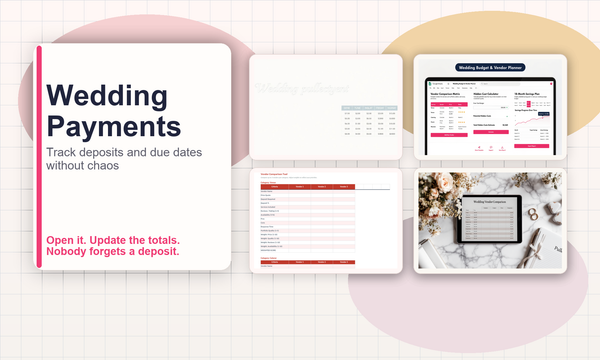
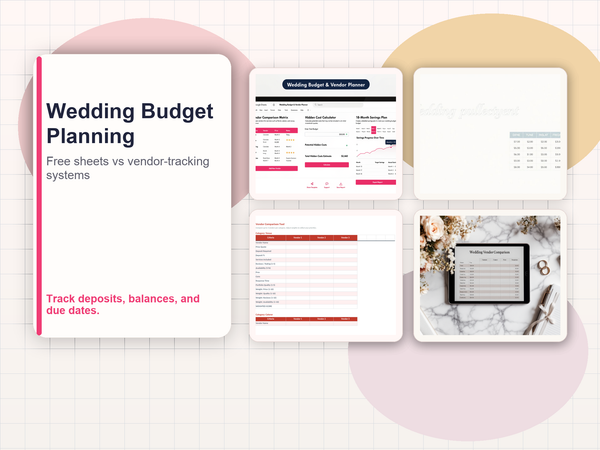
Get the Wedding Budget & Vendor Planner → Includes dual income tracking, vendor payment schedules, proportional expense splitting, and a post-wedding budget handoff. £4.99 on Payhip.
Why You Need a Budget Template for Newlyweds
A standard budget spreadsheet has one income field, one set of expense categories, and one savings goal section. That worked when you were single. It falls apart the moment two people try to use it.
Two incomes on different schedules. One of you might get paid on the 25th, the other on the last Friday of the month. A single "monthly income" field doesn't capture the cash flow reality of two salaries landing at different times.
Shared vs. Individual expenses. Rent is shared. Your gym membership probably isn't. Groceries are shared. The £15/month you spend on a podcast subscription is yours. A single-person template lumps everything together. Newlyweds need three categories: shared fixed, shared variable, and individual.
Different spending habits. One of you tracks every purchase in a Notes app. The other checks their bank balance once a week and hopes for the best. Neither approach is wrong, but they collide badly without a shared system. The tracker feels anxious. The winger feels surveilled.
Joint savings goals that didn't exist before. A house deposit. A car. Starting a family. Paying off £4,000 of wedding credit card debt. These shared goals need shared tracking, shared contributions, and shared visibility on progress.
The income gap problem. If one partner earns £42,000 and the other earns £28,000, splitting everything 50/50 means the lower earner has almost no discretionary money. A couples budget template with proportional splitting fixes this, but most newlyweds don't know that's an option until the resentment builds.
The Three Money Models for Newlyweds
Before you pick a template, you need to pick a model. How you structure your accounts matters more than which spreadsheet you use.
Model 1: Fully Joint
Both salaries go into one joint account. All bills, savings, and spending come from the same pot. Each person gets a fixed "personal spending" amount transferred to individual accounts.
Pros:
- Maximum simplicity. One account to track, one dashboard to check
- Total transparency. Nothing is hidden
- Easier for mortgage applications (lenders like seeing a joint account with consistent income)
Cons:
- Every purchase is visible, which can create friction over small spending
- Requires high trust and similar money attitudes from day one
- If one person is a spender and the other is a saver, the saver ends up policing
Best for: Couples with similar incomes and similar spending habits who want full financial partnership.
Model 2: Yours, Mine, Ours (Three Accounts)
Each person keeps a personal account. You open a joint account for shared expenses. On payday, each person transfers their agreed contribution to the joint account. Whatever stays in personal accounts is individual money. No questions asked.
Pros:
- Financial autonomy preserved. Buy what you want with your own money
- Shared expenses are clearly funded and tracked
- Reduces arguments over personal spending
- Each person maintains their own financial identity and credit history
Cons:
- Requires calculating and agreeing on contribution amounts
- Three accounts means more admin
- Can feel transactional if you're not careful about framing it
Best for: Most newlyweds. It balances togetherness with independence and gives you a structure that scales as your financial life gets more complex.
Model 3: Fully Separate with Shared Bills
No joint account. Each person pays specific bills from their own account. You reconcile at the end of the month using a spreadsheet.
Pros:
- Complete financial independence
- No joint account admin
- Each person is fully responsible for their own money
Cons:
- Reconciliation gets tedious fast
- Easy to lose track of who owes what
- Feels less like a partnership and more like flatmates splitting rent
- Harder to save jointly for big goals
Best for: Couples who are recently married and not ready for account merging, or where one partner has complex financial situations (self-employment, existing debts, business accounts).
Our recommendation for most newlyweds: start with Model 2. It's the easiest to set up, the least likely to cause arguments, and you can always move toward fully joint later once you've built the shared money habits.
5 Approaches to Tracking Joint Finances
Here's what works, with honest assessments of each.
1. DIY Google Sheets Spreadsheet
Platform: Google Sheets / Price: Free / Setup time: 45-90 minutes
Pros:
- Free forever, fully customisable to your exact income split
- Both partners can edit simultaneously on phone or desktop
Cons:
- Takes a full evening to set up properly, easy to break formulas
- Manual data entry gets abandoned by month three for most couples
Verdict: Great if one of you genuinely enjoys spreadsheets. But "I'll build us a budget spreadsheet" is one of those post-wedding promises that joins "I'll frame the wedding photos" in the pile of good intentions.
2. Emma (App)
Platform: iOS, Android / Price: Free; Pro from £4.99/month
Connects to both partners' bank accounts and categorises transactions automatically.
Pros:
- Automatic transaction import from multiple banks
- Both partners can link accounts for a household view
- Bill reminders and clean interface non-spreadsheet people actually use
Cons:
- Pro costs £4.99/month (£60/year). No proportional income split calculator
- Joint and personal account transactions get mixed together
- Category detection is imperfect. Wedding payments linger in wrong buckets for months
Verdict: Decent for automatic tracking, but it doesn't understand the yours/mine/ours structure, so you'll need to mentally separate what it shows you.
3. Monzo/Starling Joint Account with Built-In Budgeting
Platform: iOS, Android / Price: Free (joint account)
Open a joint account with a digital bank that has built-in spending categories, pots/spaces for saving, and real-time notifications.
Pros:
- Joint account and budgeting in one, with instant spend notifications
- Pots/spaces ring-fence money for specific goals (wedding debt, house deposit, holiday)
- Salary sorting rules automate the split on payday
Cons:
- Only tracks the joint account. Personal spending stays invisible
- No proportional split calculator or debt payoff planning
- Limited reporting, no year-over-year comparison
Verdict: Excellent as the "ours" account in a three-account setup. But it only shows half the picture. You still need something to track the full household budget across all accounts.
4. YNAB (You Need A Budget)
Platform: Web, iOS, Android / Price: $14.99/month ($99/year)
Zero-based budgeting where every pound gets assigned a job. Supports multiple accounts, goals, and debt tracking.
Pros:
- Powerful debt payoff tracking (useful for wedding credit card balances)
- Goal tracking with target dates and required monthly contributions
- Both partners use one account simultaneously
Cons:
- $99/year is steep when you're paying off wedding debt
- Steep learning curve. Takes weeks to click
- American-centric (dollar-focused UI, US-specific bank connections)
Verdict: The most powerful option, but the cost and learning curve make it hard to recommend for newlyweds who just need to get organised. If you're carrying significant wedding debt and want military-grade tracking, consider it. Otherwise, more tool than most couples need.
5. Pre-Built Spreadsheet Template
Platform: Google Sheets / Price: £4.99 (Wedding Budget & Vendor Planner)
A ready-made spreadsheet built specifically for couples planning a wedding and merging finances after. Covers vendor tracking, payment schedules, dual income budgeting, proportional splitting, savings goals, and debt payoff planning in one place.
Pros:
- Ready to use in under 10 minutes, one-time cost, no subscription
- Tracks wedding vendors alongside your post-wedding household budget
- Both partners edit simultaneously on any device
Cons:
- Manual data entry, no automatic bank connection
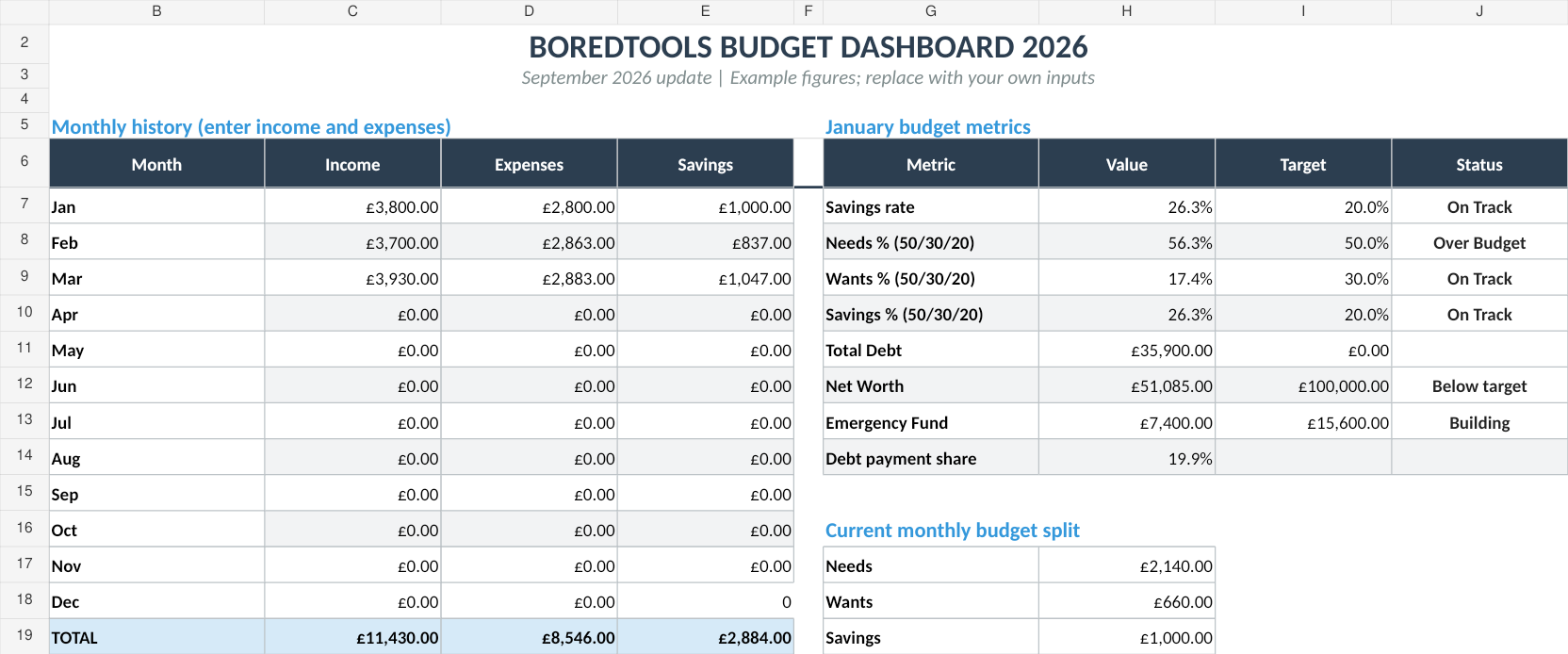
The Wedding Budget & Vendor Planner (£4.99) handles both sides: vendor payments before the wedding and the financial merge after. If you want an ongoing household dashboard with savings goals, debt tracking, and year-over-year comparisons, pair it with the Budget Dashboard 2026.
UK edition built for British finances. HMRC Self Assessment categories, council tax tracking, National Insurance (Class 2 and Class 4) calculations, ISA allowances, and GBP formatting throughout. US edition included with IRS tax brackets, 401(k) tracking, and USD formatting.
Verdict: Best balance of cost, flexibility, and newlywed-specific features. No subscription eating into the budget you're building.
Grab the Wedding Budget & Vendor Planner for £4.99 on Sort & Keep →
What a Budget Template for Newlyweds Must Include
Whatever tool you choose, make sure it handles these. They're the things that separate a generic budget from one that actually works for two people who just got married.
Dual Income Tracking with Proportional Split
Both incomes listed separately, with an automatic calculation of each person's percentage of household income. If Partner A earns £2,800/month and Partner B earns £2,200/month, the template should show Partner A contributes 56% and Partner B contributes 44%. Every shared expense splits according to those percentages. Automatically.
This single feature prevents more arguments than anything else. Nobody is paying "more than their fair share" because the share is mathematically proportional.
Joint vs. Individual Expense Categories
Three clear sections:
- Joint fixed: Rent/mortgage, utilities, council tax, insurance, groceries, broadband
- Joint variable: Eating out together, date nights, home improvements, gifts for family
- Individual: Personal subscriptions, hobbies, clothing, lunches at work, personal care
The individual category is non-negotiable. Every financial advisor worth listening to says the same thing: some money must be "yours" with no accountability to your partner. The point is protecting the relationship, not running a financial audit on each other.
Wedding Debt Payoff Tracker
If you financed part of the wedding on credit cards or a personal loan, you need a dedicated section tracking:
- Total remaining balance
- Interest rate per card/loan
- Minimum monthly payment
- Actual monthly payment (ideally more than the minimum)
- Projected payoff date at current payment rate
The average UK couple who borrows for their wedding takes on around £3,000-£5,000 in wedding debt. At 22% credit card interest, a £4,000 balance with minimum payments takes over 10 years to clear and costs £3,200 in interest. A structured payoff plan, even an extra £100/month, cuts that to under three years.
Our debt payoff calculator can help you compare snowball vs. avalanche methods to find the fastest route clear.
House Deposit Goal Tracker
For most UK newlyweds, the next big goal after clearing wedding debt is a house deposit. The average first-time buyer deposit sits around £53,000 (Nationwide), though this varies massively. £15,000-£20,000 in parts of the North, £80,000+ in London and the South East.
Your template should track target amount, current savings, monthly contribution from each partner, progress percentage, and estimated completion date. Watching that progress bar move from 12% to 15% to 20% is the kind of shared motivation that keeps both partners engaged long after the novelty wears off.
Marriage Tax Allowance Calculator
This is free money that many newlyweds don't claim. If one partner earns under £12,570 (the personal allowance) and the other is a basic rate taxpayer (earning under £50,270), the lower earner can transfer £1,260 of their personal allowance to the higher earner. That saves the higher-earning partner £252 per year in tax. And you can backdate it up to four years.
Your budget should include a line item for this. It's not a fortune, but £252/year is £21/month toward that house deposit, and it costs nothing to claim. Apply through HMRC online. Takes about 10 minutes.
Even if both partners earn above the personal allowance now, track this. If one partner takes parental leave or goes part-time after having children, the allowance transfer may become available.
The First Month: Getting Set Up
Week 1: The Numbers Conversation. Sit down together and lay out the full picture. Every account, every debt, every subscription, every income source. No surprises. Financial vulnerability with another person takes trust. Do it anyway.
Week 2: Pick Your Model and Open Accounts. If you're going with yours/mine/ours (and we think you should), open a joint current account. Set up standing orders from each personal account to the joint account, timed for the day after each person gets paid.
Week 3: Set Up the Template. Whether you use the Wedding Budget & Vendor Planner to carry your planning data into married life, or a standalone couples template, get the real numbers in. Both incomes, the proportional split, every shared expense, individual budgets, savings goals, wedding debt if applicable. If you need ongoing month-by-month tracking, the Budget Dashboard 2026 picks up exactly where the wedding planner leaves off.
Week 4: First Money Meeting. Fifteen minutes. First Sunday of the month, spreadsheet open. Cover three things: Were we under or over on shared expenses last month? Anything unusual coming up? How are the goals progressing? That's it. Do not use this meeting to interrogate each other's personal spending. That's what the individual category is for.
One rule that saves marriages: agree on a notification threshold for joint spending. Maybe £75, maybe £150. Above that amount, give the other person a heads up before spending from the joint pot. Not asking permission. Just a heads up.
Start Here
You don't need the perfect financial system in month one of your marriage. You need one that's good enough to use consistently.
- Have the numbers conversation. All accounts, all debts, all income.
- Choose the yours/mine/ours model. It works for most newlyweds and preserves individual autonomy while building a shared financial life.
- Open a joint account. Set up automated transfers on payday.
- Grab the Wedding Budget & Vendor Planner for £4.99 → and fill in your real numbers. It covers vendor tracking, wedding spend, and the post-wedding financial merge in one sheet.
- Check the Marriage Tax Allowance. If one of you earns under £12,570, claim the £1,260 transfer immediately. It's £252/year for 10 minutes of paperwork.
- Schedule the first money meeting. 15 minutes. Keep it positive. Adjust the numbers, not the person.
The wedding is the event. The marriage is what comes after. And it runs better when both people are looking at the same numbers.
Related Reads
- Budget Template for Couples: How to Manage Money Together
- Budget Template for New Parents: First Baby Budget Planner
- Best Wedding Budget Spreadsheets in 2026
- Wedding Budget and Vendor Planner
- Best Budget Spreadsheet Templates in 2026
Get free spreadsheet templates and updates. New templates, feature updates, and practical guides delivered to your inbox. No spam, unsubscribe anytime.
Subscribe free → | Already have a template? Download the free budget tracker or free meal planner. No email required.
Choose the right next step
The Wedding Budget & Vendor Planner is a wedding vendor payment tracker spreadsheet for budgets, deposits, due dates and final balances in one place.