Meal Planning for Families with Picky Eaters: The Spreadsheet Approach
Meal planning for picky eaters using spreadsheets. Track food preferences per person and build modular meals. Get the template.

From Sort & Keep, the maker of the linked templates. Our current product prices update with your selected currency. Worked examples and third-party prices keep their stated currency and date.
About 50% of parents report having at least one picky eater at home. If that's you, the consequences are familiar: cooking 2-3 different meals every night, throwing away food nobody touched, and eventually giving up on meal planning for picky eaters altogether because what's the point of a weekly plan when half the family refuses to eat what you made?
We've watched families cycle through the same pattern. Download a meal planning app. Get excited about the recipe suggestions. Realise by Wednesday that the 7-year-old won't eat anything with visible onions, the 4-year-old has decided she hates chicken this month, and the whole system collapses. The problem isn't a lack of willpower. It's that the tools weren't designed for the actual problem.
Why Meal Planning Apps Fail Picky Families
Standard meal planning tools assume everyone at the table will eat the same thing. They generate recipes, build grocery lists, and call it done. For a household where everyone eats everything, that works. For a household with picky eaters, it's useless on day one.
Generic recipe suggestions nobody will eat. The app says "teriyaki salmon with stir-fried vegetables" and you already know three people at your table will reject it. You skip it, scroll past 20 more suggestions, and end up planning the same five meals you always make. The app added zero value.
No per-person preference tracking. Most apps have a single dietary profile. You can mark "no shellfish" or "vegetarian" but you cannot say "Person A won't eat mushrooms, Person B won't eat anything with a sauce, Person C only eats carrots if they're raw." Picky eating is a matrix of individual preferences that shifts over time. No app models this.
No nuance in food rejection. Your child won't eat tomatoes but will eat tomato sauce. Won't eat chunks of onion but is fine with onion powder. Refuses "spicy" food but inhales pepperoni. Picky eating is about texture, visibility, temperature, and presentation as much as flavour. A binary "likes/dislikes" toggle misses all of this.
No gradual exposure support. Research is clear: repeated, low-pressure exposure works. It can take 10-15 exposures before a child accepts a new food. But no app tracks this. There's no way to say "we've tried green beans 6 times, she touched it twice and tasted it once. Keep it in rotation."
The Picky Eater Meal Planning Framework
Before we get into specific tools, here's the framework that actually works. We've refined this across dozens of families, and it has three layers.
Layer 1: The Per-Person Food Acceptance Matrix
For each family member, create a profile that classifies foods into categories:
- Always eats. Reliable, no complaints
- Eats sometimes. Depends on preparation method or mood
- Will tolerate. Won't choose it but won't refuse it on the plate
- Currently rejected. Actively refuses
- Never tried. Hasn't been offered yet
This is more useful than a binary yes/no because it captures the gradient. A food in the "eats sometimes" column tells you it can work in the right context. A food in "currently rejected" is a candidate for gradual exposure, not permanent removal.
Add columns for preparation notes. "Carrots: only raw, cut into sticks" or "Cheese: only melted, never cold slices." These details make the difference between a meal that works and a meal that ends in tears.
Layer 2: Shared Base Meals with Modular Components
Stop trying to find one recipe everyone will eat. Instead, build meals from a shared base with swappable components.
Example: Taco night. The base is seasoned mince and tortillas. Person A gets cheese, lettuce, and salsa. Person B gets cheese only. Person C gets the mince plain in a bowl with rice instead of a tortilla. One cooking session, one base, three versions. The meal plan tracks the base recipe and each person's modification.
Layer 3: Gradual Exposure Tracking
For each "currently rejected" food, track the date of each exposure, the type (on the plate, touched, tasted, ate a small amount, ate a full portion), and the context (alongside a preferred food? new preparation method?).
Over 8-12 weeks, patterns emerge. Maybe your child will taste new foods when they're alongside something familiar. Maybe they accept vegetables better when they helped prepare them. The data tells you what's working so you can stop guessing.
Meal Planning for Picky Eaters in a Spreadsheet
A spreadsheet is genuinely the best tool for this because picky eating is a data problem. You need cross-referencing, conditional logic, and the ability to update one profile and have it ripple through every meal plan. Here's what each tab does.
Tab 1: Family Member Profiles
One row per food item. One column per family member. Each cell contains the acceptance level (always, sometimes, tolerates, rejected, untried) plus a preparation note. This is your master reference. Every other tab pulls from it. A family of four tracking 80 common foods can complete this in 20 minutes because you already know what your kids will and won't eat.
Tab 2: Meal Ideas Database
A list of 30-50 meals your family actually makes, each tagged with key ingredients. The spreadsheet cross-references these against the family profiles and shows a compatibility score: "4/4 will eat the base" or "3/4. Person B rejects mushrooms, substitute with courgette." You're working with your actual repertoire, not browsing 10,000 internet recipes.
Tab 3: Weekly Planner with Cross-Reference
Drop a meal into a day slot, and the planner automatically shows which family members will eat it as-is, which need modifications, a combined grocery list for the week, and estimated prep time. Instead of mentally running through "will Jake eat this? What about Sophie?" the spreadsheet does it instantly. You see the conflicts before you shop, not at 6pm when dinner is already on the stove.
Tab 4: Food Exposure Log
A simple log: date, family member, food item, exposure type, notes. When you can show your partner (or your paediatrician) that your child has gone from refusing broccoli entirely to tasting it voluntarily after 11 exposures, that's real data.
Tab 5: Nutritional Safety Net
Tracks whether your picky eater is getting the nutrients they need despite their restricted diet. Flags gaps before they become problems. More on this below.
Meal Planning for Picky Eaters: Approaches Compared
Here are the main considerations.
1. Mealime App
Platform: iOS, Android, Web
Price: Free (basic), $5.99/month (Pro)
What it does: Recipe-based meal planner with dietary filters and auto-generated grocery lists.
Pros:
- Clean interface, genuinely easy to use
- Good range of quick recipes (most under 30 minutes)
- Grocery list generation groups by store section
Cons:
- Single dietary profile only. No per-person preferences
- No modular meal building or component swapping
- No exposure tracking whatsoever
- Pro subscription adds up to ~$72/year
Verdict: Fine for a single adult with straightforward preferences. Useless for a family where each person has different food hang-ups.
2. Yummly App
Platform: iOS, Android, Web
Price: Free (ad-supported), $4.99/month (Pro)
What it does: Recipe discovery with taste preference learning and dietary filters.
Pros:
- Learns your taste preferences over time through thumbs up/down ratings
- Large recipe database with good photos
- Can filter by dietary restriction and disliked ingredients
Cons:
- Preference learning is per-account, not per-family-member
- The "disliked ingredients" filter is binary. No nuance for preparation method
- Suggestions skew toward aspirational cooking, not weeknight reality
- No exposure tracking or acceptance-level granularity
Verdict: The closest any app gets to understanding picky eating, but it models one person's preferences, not a family's matrix.
3. Etsy/Gumroad Meal Planning Templates
Platform: Google Sheets or Excel
Price: Typically $3-$12 one-time
What they do: Pre-formatted weekly planners with grocery list tabs.
Pros:
- One-time cost, no subscription
- You own the file and can modify it
Cons:
- Nearly all are designed for one household eating the same meals
- No per-person preference profiles or cross-referencing
- Most lack formulas entirely. Essentially formatted PDFs in spreadsheet form
- No exposure tracking
Verdict: You'll spend hours retrofitting a generic template to handle picky-eater logic. At that point, start from a purpose-built template or build your own.
4. The DIY Google Sheets Approach
Platform: Google Sheets (free)
Price: Free
What it does: Whatever you build it to do.
Pros:
- Completely free, total control over every data point
- Can implement the full framework: acceptance matrix, modular meals, exposure log
- Shareable with partner for real-time collaboration
Cons:
- You have to build everything from scratch
- Cross-referencing formulas get complex fast
- Time investment: 4-8 hours to build, plus ongoing maintenance
- Easy to break if you're not comfortable with VLOOKUP/INDEX-MATCH
Verdict: The most powerful option if you have the skills and time. The barrier is 4-8 hours of setup and the spreadsheet literacy required to build the cross-referencing logic.
5. Sort & Keep Meal Planning Spreadsheets
Platform: Google Sheets and Excel
Price: Free (Weekly Meal Planner), £12.99 (Multi-Allergy Family Meal Planner)
We built two spreadsheets that handle different parts of this problem.
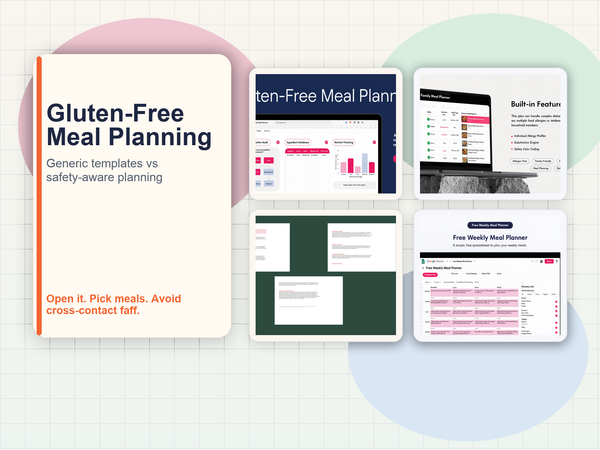
The Free Weekly Meal Planner (Sort & Keep) gives you a structured weekly planning framework with grocery list generation. It's the foundation: plan your meals, generate your shopping list, track what you're spending. You can adapt it for picky eaters by using the notes fields to track per-person modifications. It won't do the cross-referencing automatically, but it's a solid starting point and it costs nothing.
The Multi-Allergy Family Meal Planner (£12.99) (Sort & Keep) supports up to 6 family member profiles, each with their own restriction flags. The cross-referencing engine shows which meals work for everyone and which need per-person modifications. While it was designed for allergy families, the per-person profile system works equally well for picky eaters. Swap "allergic to tree nuts" for "refuses anything with visible onions" and the logic is identical.
UK edition built for your kitchen. Portions in grams, ingredient names you'll recognise (courgette not zucchini, coriander not cilantro), and nutritional data from McCance and Widdowson. US edition included with USDA data and American measurements.
Pros:
- Per-person profiles with individual food flags (up to 6 family members)
- Cross-referencing that shows meal compatibility across the whole family
- One-time purchase, no subscription
- Formulas are built and protected. Nothing breaks when you add your own data
- The free planner lets you test the approach before committing
Cons:
- The Multi-Allergy Planner doesn't include a dedicated exposure tracking tab (you'd add this yourself)
- Designed primarily for allergy logic, so the vocabulary is "safe/unsafe" rather than "accepts/rejects/tolerates"
- No built-in recipe database. You populate it with your family's meals
Verdict: The closest existing tool to the full picky-eater framework. The per-person profile system and cross-referencing engine solve the hardest part of the problem. Knowing which meals work for which family members without mentally running through everyone's preferences. Add an exposure log tab yourself and you've got the complete system.
For a deeper comparison of meal planning spreadsheets across all dietary needs, see our best meal planning spreadsheet templates for 2026.
The Nutritional Safety Net: Making Sure Picky Eaters Still Get What They Need
This is the part that keeps parents up at night. If your child only eats 15 foods, are they getting enough nutrients?
The honest answer: probably not across every micronutrient, but the gaps might be smaller (or different) than you think.
The Nutrients Most At Risk for Picky Eaters
Research consistently flags these as the most common deficiencies in children with restricted diets:
- Iron. If they refuse red meat and most green vegetables. Target: 7-10mg/day for ages 4-8
- Zinc. Commonly low when meat intake is limited. Target: 5-8mg/day for ages 4-8
- Vitamin A. If they won't eat orange/yellow vegetables or leafy greens. Target: 400-600mcg/day
- Fibre. Almost universally low in picky eaters who avoid vegetables. Target: 15-25g/day depending on age
- Calcium. If dairy is refused. Target: 700-1000mg/day for ages 4-8
How to Track This in a Spreadsheet
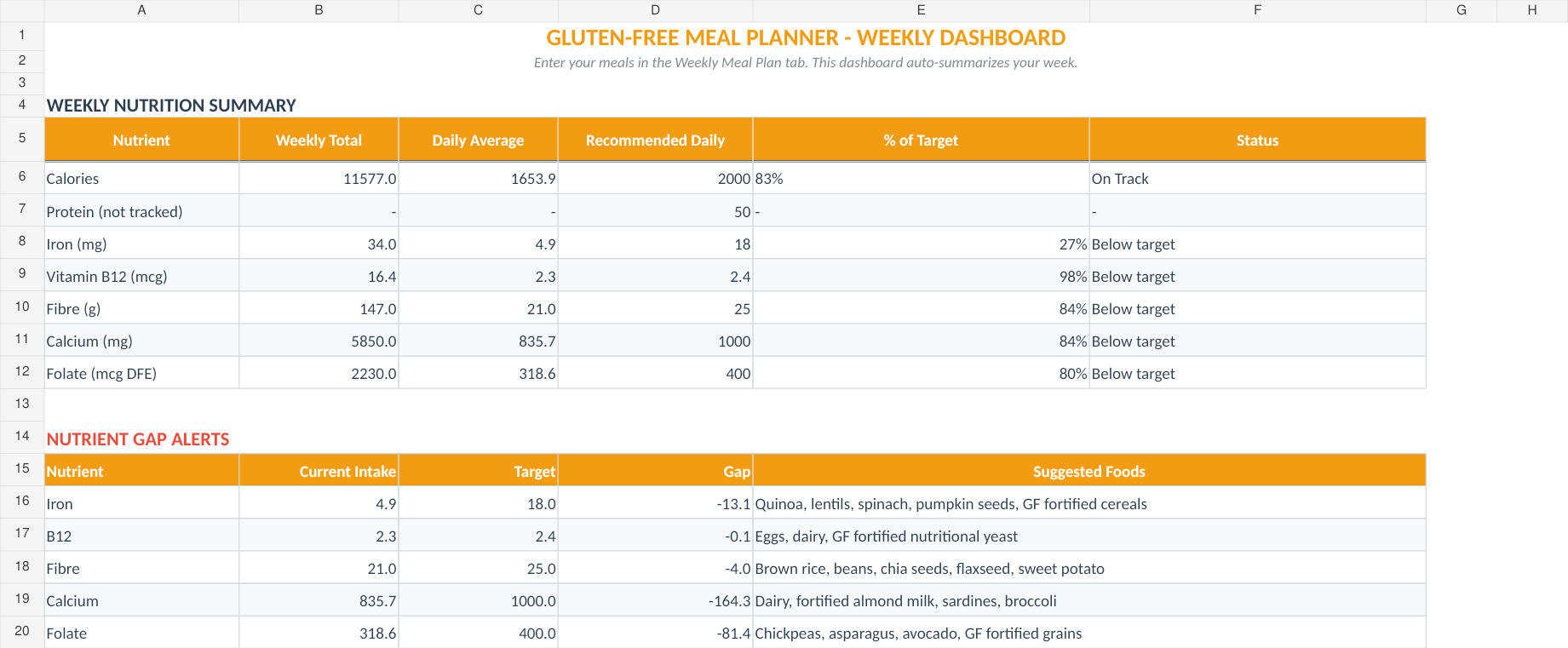
Add a nutritional tracking tab that logs what your picky eater actually ate each day (not what was offered. What was consumed). Map each food to its key micronutrient contributions using a simple lookup table. The spreadsheet shows daily totals against recommended intake and flags anything below 70% consistently.
You don't need to track 30 micronutrients. Track these five. If your child is consistently below 70% of any target over a 2-week period, that's a conversation for your GP or a paediatric dietitian. Not a reason to panic, but a reason to act.
The Supplement Question
We won't pretend a spreadsheet replaces a dietitian. But a children's multivitamin costs about £3-5/month and covers the most common gaps. Many paediatricians recommend one for picky eaters as a safety net while you work on expanding the diet. Track whether you're giving it in the spreadsheet. Consistency matters more than the brand.
Practical Tips That Actually Work
Start with what they eat, not what they should eat. List every food your child currently accepts. Most parents are surprised to find it's 20-30 items, not 5. That's a workable foundation.
The "one bite" rule is outdated. Current research favours repeated exposure without pressure. Put the new food on the plate alongside accepted foods. Don't comment on it. Don't bribe. Log whether they interacted with it.
Cook the same base, assemble differently. Pasta night: plain butter pasta for the picky eater, pesto pasta for you, marinara for your partner. One pot of pasta, three sauces.
Involve the picky eater in planning. Let them look at the weekly plan and choose one new food to try. Autonomy reduces resistance.
Review the data monthly. After a month, you can see which foods moved from "rejected" to "tolerates." After three months, you'll have hard evidence of progress. Even if day-to-day it feels like nothing is changing.
Who This Approach Is For
- Parents with 1-3 picky eaters who are tired of cooking multiple meals and want a system that accounts for individual preferences
- Families where picky eating is causing nutritional anxiety and want data to confirm or calm their concerns
- Parents working with a feeding therapist who need structured exposure logs and food acceptance records
- Anyone who's tried meal planning apps and abandoned them because the suggestions were irrelevant
Our Recommendation
Don't start with an app. Start with a spreadsheet. The apps are built for a world where everyone eats the same dinner. Your world has a child who ate broccoli last Tuesday but screamed at it on Thursday, a partner who "doesn't like fish" except for fish and chips, and a toddler whose accepted food list changes weekly.
A spreadsheet models your family, not a generic household. The acceptance matrix is the foundation. The modular meal approach is the strategy. The exposure log is the long game.
If you want to build from scratch, Google Sheets is free and the framework above is your blueprint (budget 4-8 hours). If you want a head start, grab the Free Weekly Meal Planner (Sort & Keep) for the planning structure, then add the Multi-Allergy Family Meal Planner (£12.99) (Sort & Keep) for per-person profiles and cross-referencing. Adapt the allergy profiles for picky eating preferences and you'll have a working system in under an hour.
Meal planning for picky eaters isn't a recipe problem. It's a data problem. And spreadsheets are how you solve data problems.
Related Reads
- Best Meal Planning Spreadsheet Templates in 2026
- Grocery Budget Tracker Template
- How to Meal Prep on a Budget
- Multi-Allergy Family Meal Planner: Safe Meals When Everyone Has Different Allergies
Get free spreadsheet templates and updates. New templates, feature updates, and practical guides delivered to your inbox. No spam, unsubscribe anytime.
Subscribe free → | Already have a template? Download the free budget tracker or free meal planner. No email required.
Choose the right next step
Start with the Free Weekly Meal Planner for a basic week and grocery list. For a dietary workflow, choose the gluten-free planner, vegan meal-prep planner, keto and low-carb planner, multi-allergy family planner. The Meal Planning Bundle puts all four specialist workbooks in one purchase.